Zenith Royal 32 – 35 – 640 – 645 – 645L Portables
(And another story of some very confusing model numbers)

Above: Royal 35 Variants
Homonyms are words that sound alike but have very different meanings, like bat (the flying kind) and bat (the baseball kind). Zenith, like some other manufacturers (such as Sony) often played games with confusing model numbers, using similar model numbers for very different radios and conversely, issuing very different model numbers for some very similar radios. Clearly this was driven by marketing considerations and sometimes getting to the bottom of such confusion requires obtaining multiple samples of some models, collecting all of the service information available and finding pictures online. I also have pictures of other radios which look different but have one of these model names as you will see. Let’s jump in with a bit of history, then we’ll look at the models in more detail.
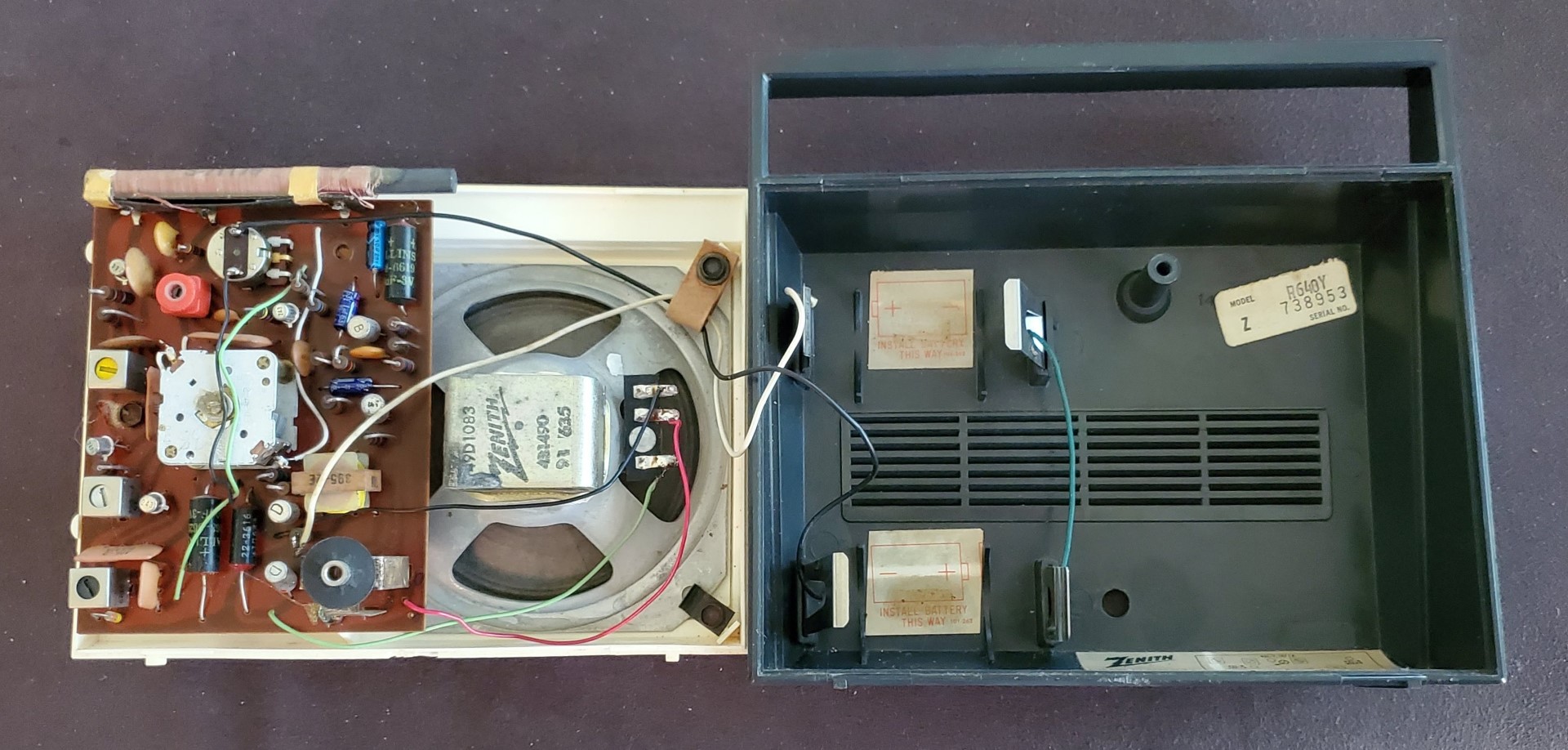
Above: Royal 35 -Sticker Inside Says R640Y (Yellow)
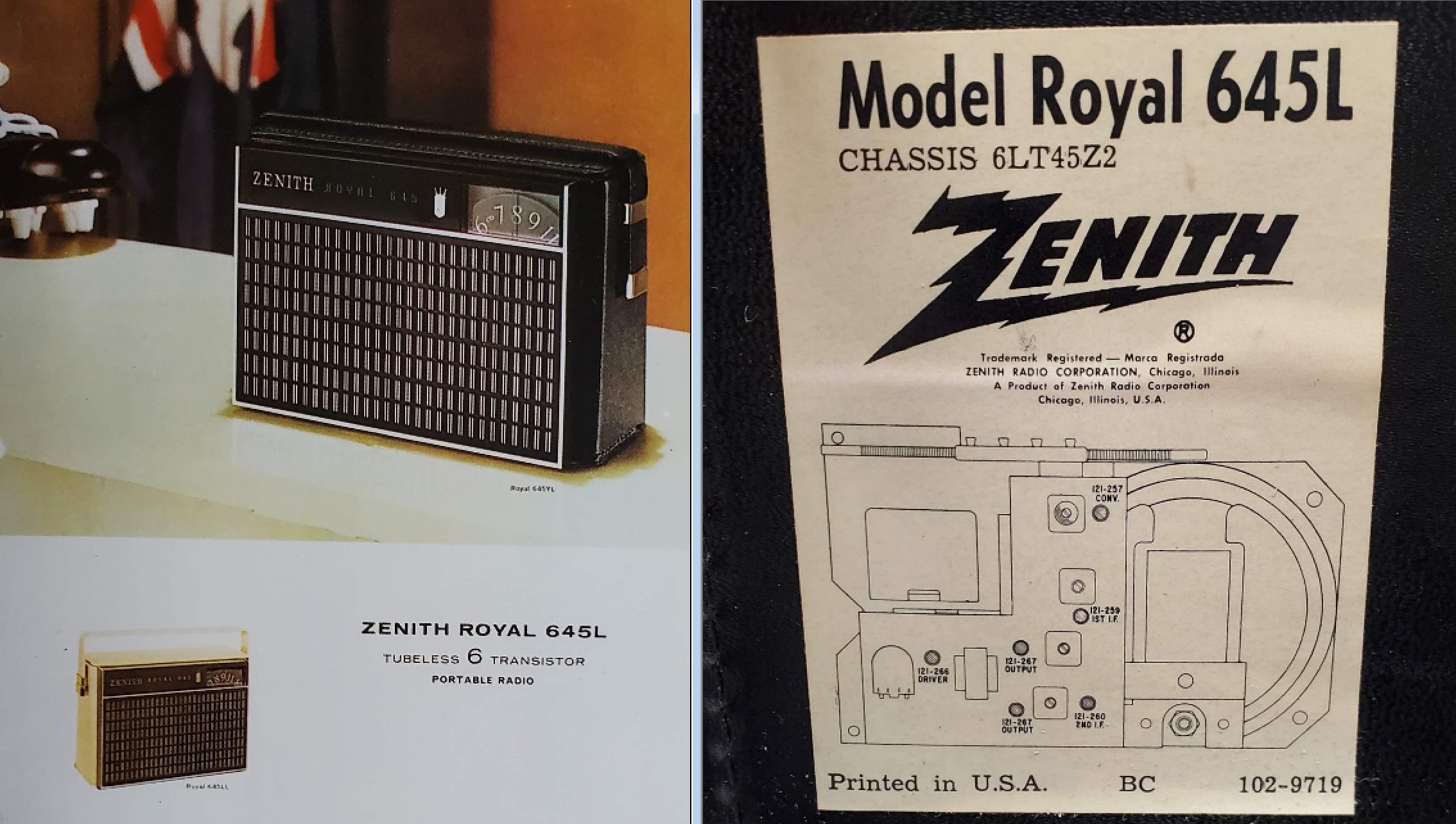
This series debuted in 1961 with the Royal 650, a mid-sized, mid-priced portable with Chassis 6JT45Z1, a 6-transistor design operated by four AA cells. It had a Permawear cabinet which did not hold up well over time. In 1963 it was replaced by the Royal 645 which offered identical performance with the almost identical chassis 6KT45Z1. 1964 brought the Royal 645L with completely new styling and now running on 4 C cells and with chassis 6LT45Z2. Finally, in 1965 the marketing people announced a new Royal 645 family which included such diverse names as Royal 645, Royal 35 and Royal 32…these all used one of two nearly identical chassis 8NT45Z8 or 8NT45Z9. These were now upgraded to 8 transistor designs (although with no additional RF stage) running on two D cells which dominate the radios’ interior and which will provide many hundreds of hours of playing time. There was still an air-variable tuning gang and performance was very good but gone was the heavy metal chassis. They also utilized a fairly unusual center-tapped speaker driven by a balanced push-pull output circuit. There is a decent-sized 4” ferrite rod and with 300 – 600 mw audio output they can play quite loudly.
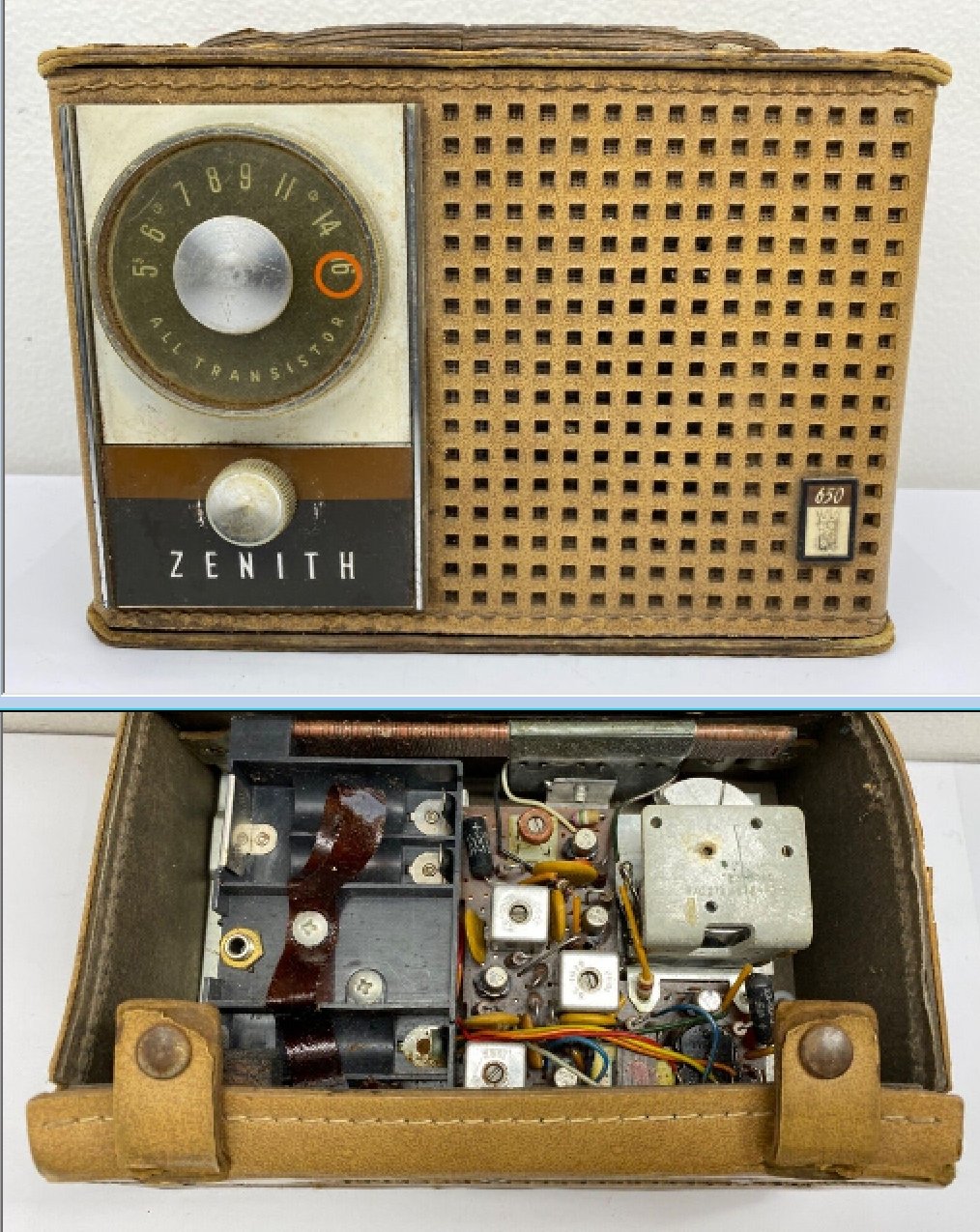
Above: Original Royal 650
But there’s more – I found a picture of a larger, heavier Royal 645 that was once in my possession years ago. Although from the front it appears to share the same physical layout as the Royal 32/35/640, the side-by-side pictures indicate it has to be a larger, older style model but I have no interior photos of it to know for sure. Zenith…what were you thinking???? The three pictures below show two radios which, from the front, could house the same chassis but look at the other two pictures and it becomes apparent they are of very different vintage and construction. I will continue to research this and will update this info if I learn more.
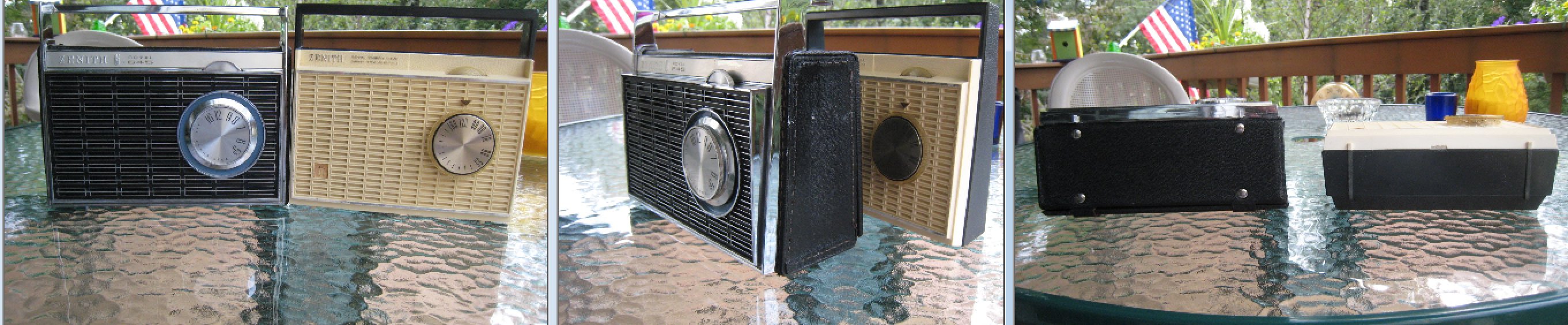
Above: They look the same from the front but are clarly not the same inside!
This project started when one of my readers who has recently suggested several nice vintage radios for me to review wrote to tell me about the Royal 645L…he told me it beat some other radios which I knew had to be better but he was convincing enough that I decided to find one. I remembered that I had a Royal 35 on the shelf which I had repaired years ago but never written up so I took it out and started to do some comparisons with other radios and sure enough inside it said R-640Y (Y for Yellow). It amazed me that the radio says Royal 35 on the outside but R-640 inside. Now I had to find a 645L along with its service manual before I could write about this series.
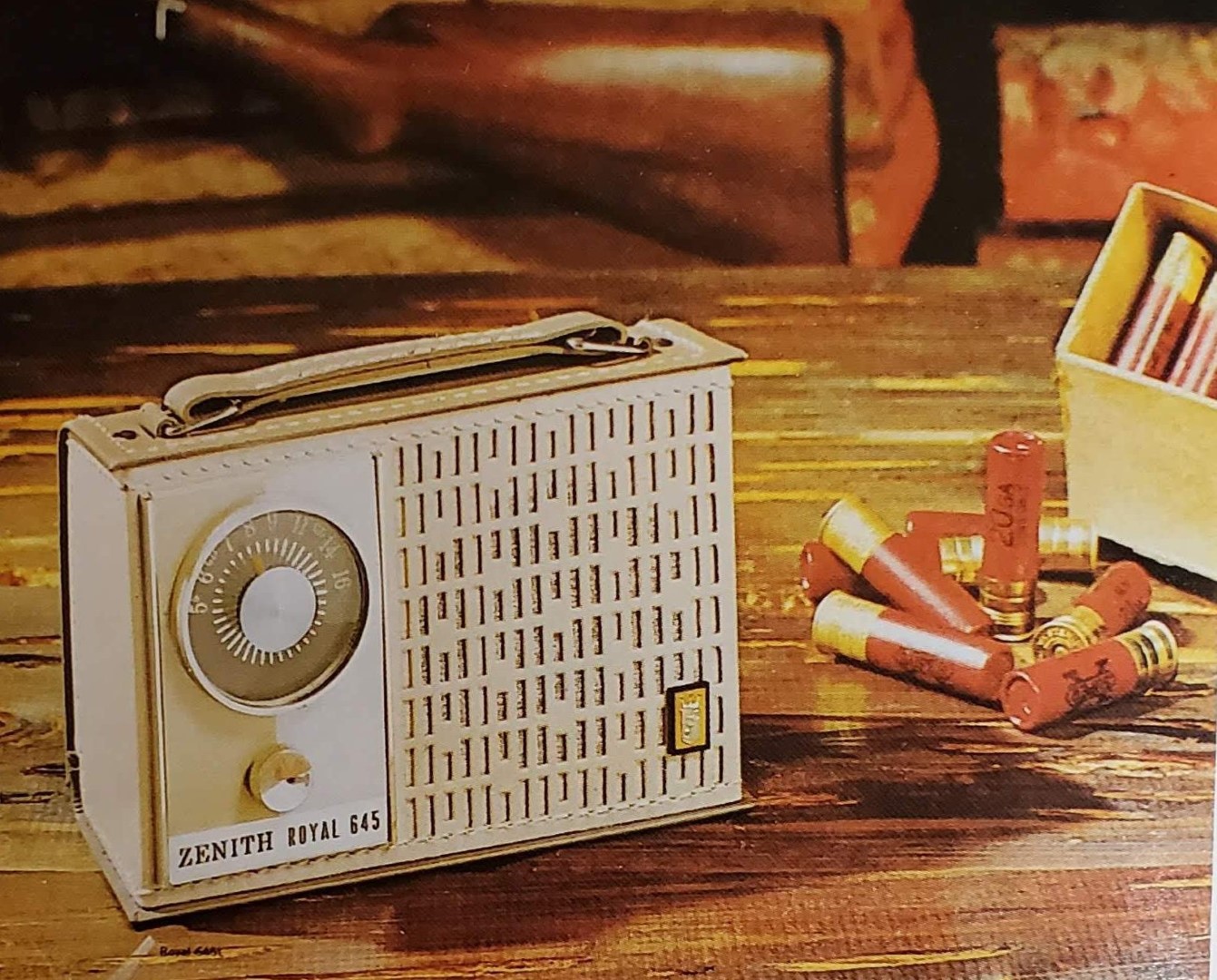
Above: Original Royal 645
Soon the 645L and its manual arrived and I began to look inside them and do some comparisons. So, I will discuss the various 640, 645, 32 and 35 series as one even though they have different physical designs and the 645L as a different model. I do not have an original 650 but the Service Manual indicates that the 640 series comments should apply to it as well.
Initial Assessment: As I mentioned above all of the various Royal 640, 645, 32 and 35 models except the Royal 645L use one of two chassis, either 8NT45Z8 or 8NT45Z9. (The Royal 35-1 from 1969 uses chassis 8XT45Z9 but again this is almost identical to the earlier ones in the series). According to the service literature these 8-transistor chassis are virtually identical although different transistors were used. Manufacturers often had to source new components as older ones became unavailable or newer choices were less expensive. Almost invariably the new parts were as close as possible to the originals so minimal circuit changes were needed to accommodate them while performance remained the same.
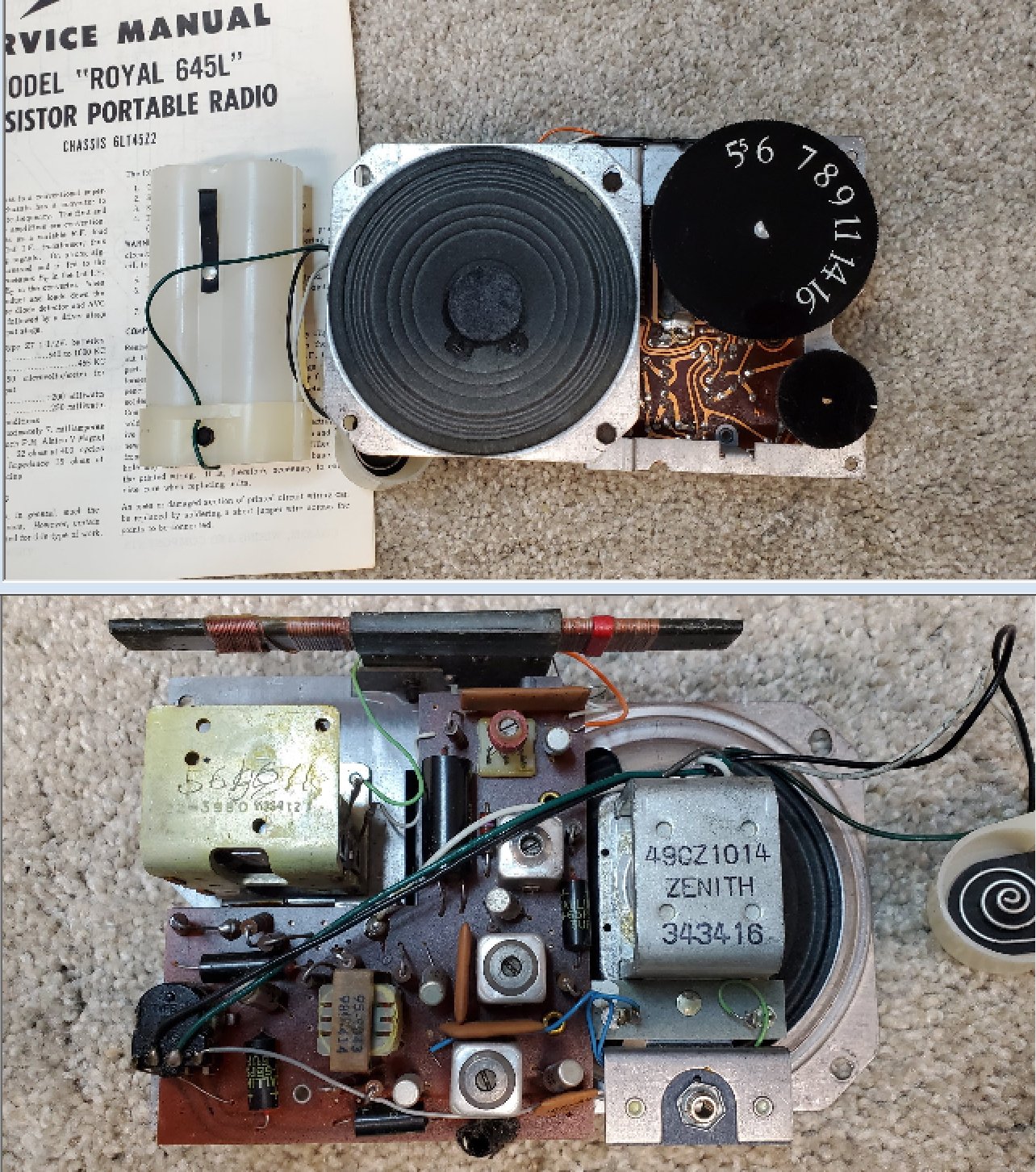
Above: Royal 645L Interior Views
Performance: I will admit I was pleasantly surprised at how well all of these radios performed and it’s not too surprising that the later 8 transistor Royal 35 slightly outperformed the 6 transistor 645L. I first compared my Royal 35 with my Royal 500H from 1961 and the Royal 35 somewhat outperformed it with stronger reception and better sound. Given that the ‘500H has an untuned RF stage while the ’35 does not I can only attribute this to the improved gain and signal to noise characteristics of the more modern transistors and the beefier ferrite rod. On weak signals both radios could always muster loud volumes but the Royal 35 was clearer and a bit less noisy, and it also had obviously better sound with a wider, flatter frequency response which is partly due to the larger cabinet. It’s certainly no boom box and does not compare with the best of today’s high-tech speakers which we are seeing more and more often but it definitely shows the progress that was being made each year in those days. While it clearly cost less to produce than the earlier 500H it just as clearly outperforms it. For a reality check I compared the Royal 35 with the upscale 755/755M series and although the 35 was surprisingly close in reception (not sound quality) the more sophisticated radios did outpull it.
The 645L is a completely different animal with a heavy metal chassis versus the plastic of the later models. It was in perfect operating condition and its alignment as received was almost spot on. I must say I was almost shocked at how well this radio works, especially as it is only a 6-transistor circuit. It is just a bit less sensitive than the later 8 transistor models and loses some volume on very faint signals compared with the Royal 35 with about the same selectivity but the 645L has slightly fuller audio. I admit I am drawn to its neat-looking tuning dial and it just sounds and feels like the heavier old-school radio it is. It greatly outperforms the 6-trasistor radios from the late 1950‘s and early 60’s.
I noticed one oddity on the 645L schematic in that the battery box has a center tap, so it provides two individual 3-volt outputs from each pair of the 4 C cells as well as 6 volts from all 4 batteries. I learned that each pair powers one of the two output transistors while the other pair powers the other transistor and the 6-volt output powers everything else which is kind of unusual.
I never expected this 6-transistor Zenith from 1964 to even approach this level of performance…it was just surprisingly good ranking **** Stars on the AM Mega Shootout list. The Royal 35 was marginally better than the 645L with somewhat greater sensitivity to very faint signals but still rates ****.
Conclusion: I must say I was amazed at how well these radios performed. I have previously written in detail about the Royal 500 series and the Royal 700 series which were both cutting edge in their categories but it appears these medium-sized options were phenomenal performers for their much lower prices. If you love vintage analog radios any of thee are worth taking a look at
 radiojayallen
You must be logged in to post a comment.