Sony ICF-5500W
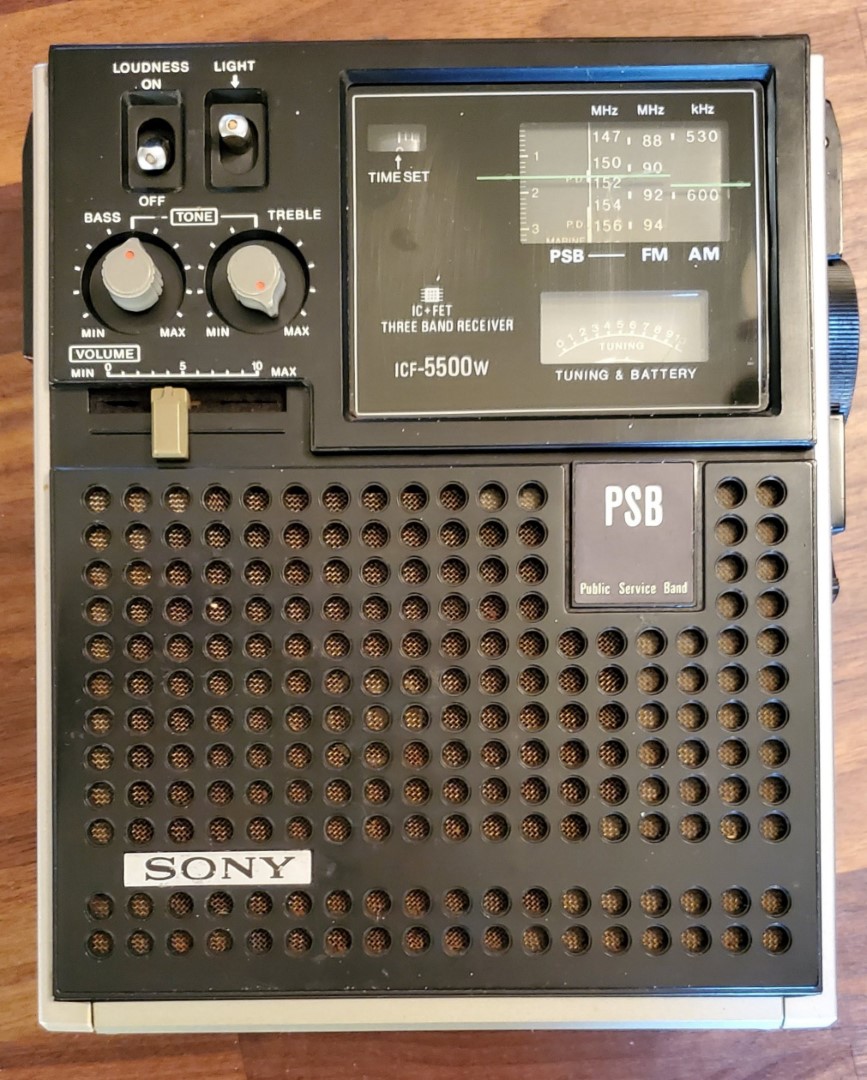
Here’s another vintage all-analog radio which a reader loaned to me for review. This guy is quite knowledgeable as he works in Vermont helping people who have trouble receiving their PBS station amidst obstructions caused by hilly terrain…talk about real world experience! He told me that among the collection of radios on which he relies the Sony ICF-5500W is among the best for FM. He sent me one on loan along with a dead set for investigation and I’m glad he did because although I had known this model existed, I never knew much about it and it has turned out to be a real find.
Introduced in 1973 the ICF-5500 was available in a few different versions with different band coverage. All cover the standard AM and FM bands, the W version adds the Public Service Band (PSB) also referred to as VHF) from 147 to 174 MHz. The M version (also known as “The Captain 55”) deletes PSB but adds the old Marine Band (MB) which is SW from 1.6 – 4.5 MHz and SW 4.5 – 12 MHz. Also of interest is that different versions used different AM IF frequencies: the usual 455 KHz in most versions but 468 in the UK version of the M variant. Although information on the web is incomplete, I read there were other variants which included LW and the Japanese FM band but as I said, information here is sketchy.
The ICF-5500W has a unique pop-up antenna which is released by pressing a button but other than that there are mostly standard controls. The top panel has a Power switch and Timer knob (for Auto Shut off* at up to 60 minutes) plus Squelch and AFC toggles. The front panel has a Volume slider, Bass and Treble knobs, a Loudness switch, Light switch, the Tuning Dial scale and a nice analog Signal/Battery Meter.

*That Timer is interesting. It is a mechanical timer which operates a DPDT (Double Pole Double Throw) switch which in effect reverses the positions of the Power Switch. With the Power Switch Off, the Timer will cause the radio to play for up to 60 minutes, then shut off. But if the Power Switch is turned ON the timer will cause the radio to be off but turn ON after the set time. Unusual to say the least.
The right side features the Tuning Knob, Band Selector and a small cubby to store the earphone.
The left side has a jack panel for DC Input (DC 4.5 Volts), Earphone (mono), Tape Record Out (mic level for connection to a cassette recorder’s mic input…many Sony cassette recorders and other portables of the time had only a mic input), Aux In, MPX Out and DC Out…the last two are used for connection to an optional matching Stereo Speaker/Amp.
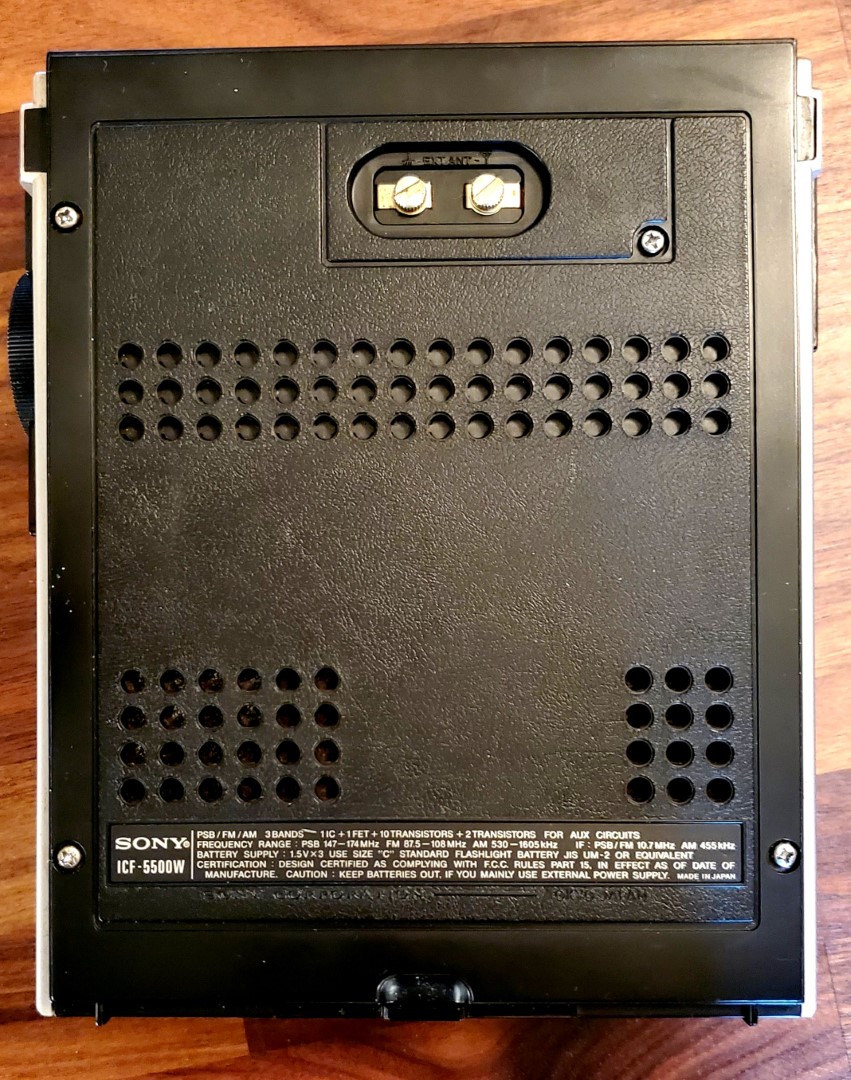
The back panel has a pair of screws for an external FM, PSB or SW Antenna (on models which include SW).
The AM section has only one filter bandwidth which I would judge to be medium…perhaps about 4 KHz…for a single bandwidth it seems appropriate. FM bandwidth is fairly narrow for very good selectivity and better than most portables of the day.
The radio is powered by 3 C cells which should provide long battery life given the radio’s all-analog design. It measures 7.1” x 8.3” x 2.6”/180 x 210 x 65 mm and weighs about 3 pounds without batteries.
Checking It Out: With the exception of the very unusual provision for a matched companion stereo speaker accessory the ICF-5500W initially struck me as a typical mid 70’s radio. Its all-analog design and freely moving tuning knob with spinner means it tunes very naturally and the large analog signal meter is a joy…such meters are more useful than most digital displays for judging relative signal levels, such as when orienting the radio or antenna for best reception. There is also a Loudness switch along with Bass and Treble controls although the sound is decidedly mellow…I kept the treble up full during all of my tests and reduced the bass as needed for the most balanced sound. The unit I received had a badly intermittent band switch but it was possible to get it to work properly with some coaxing. I didn’t do much with the Public Service Band although I did tune in my local NOAA Weather Channel but reception of the Weather Band was weak compared with modern WB radios. But what this radio is really about in 2024 is AM and FM reception and herein lies the surprise. In short, they are both excellent but the FM is more so.
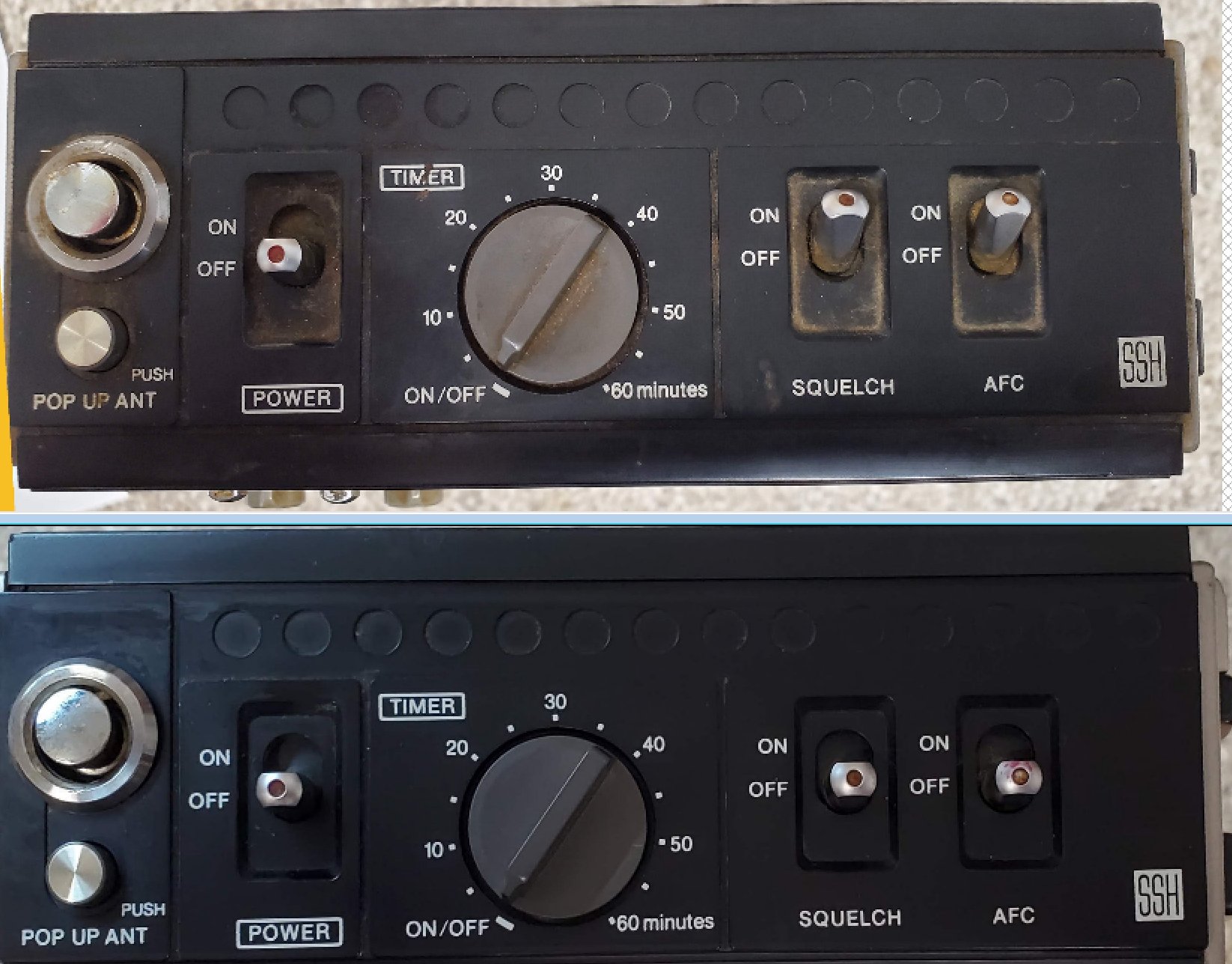
Above: A Simple Cleaning Makes a World of Difference
FM Reception: Since the owner has extensive real-world experience comparing FM radios in tough signal conditions, I checked FM reception first and I was impressed. It didn’t take long to see that this Sony was comparing well with today’s Five Star FM portables in terms of sensitivity. It was easily as sensitive as the best of them and sometimes seemed even a bit better which is amazing. Selectivity was not quite in the same league…it did have some double-tuning (meaning signals had two peaks while tuning them in) which is fairly common of older analog portables. Still, I was usually able to separate closely-spaced signals as well as my other portables…in only a few cases did the double-tuning make that less effective…it was very close. (I later aligned the radio but got no meaningful improvements…the radio seemed to have held its original factory alignment extremely well). The ICF-5500W will rate ***** in my FM Mega Shootout List…it is extremely sensitive and reasonably selective.
*As an aside it is worth noting that the radio’s owner is in a location where selectivity is not nearly as important as sensitivity. In that regard I can understand how the ‘5500 might be the best radio in his locale. He pointed out one station he can receive perfectly on the Sony which is poor on two top-rated current day DSP radios. I took out those particular radios and did an FM band scan between them and the ‘5500. The Sony was indeed extremely sensitive and received very weak FM signals as well as any other Five Star radios…very sensitive indeed. But in very crowded band conditions the DSP radios have an edge with superior filters and those radios did separate some signals which were finicky or hard to hear cleanly on the Sony. So if you are in a remote location the Sony could well be as good as any other FM portable, while in more typical locations the DSP radios will do just a hair better. But still, this is an excellent FM receiver and better than expected for a portable radio from the 70’s.
AM Reception: This was also a pleasant surprise with the Sony ranking a solid **** ½ on the AM Mega Shootout list. It has a large 6 ¼” ferrite rod and delivers strong reception of very weak signals. Its mellow tone quality also makes noisy signals more pleasant to listen to but the actual reception is strong and only a little less solid than the very best portables. This radio is a strong performer on AM and FM and again the analog tuning a smooth and has a pleasing feel.
I did not end up repairing the dead sample the reader also sent to me…access for this radio is done in several successive steps and the amount of disassembly needed to fully troubleshoot this didn’t seem practical…it will be kept as a parts set. I also bought a very cheap sample on eBay advertised as “untested” which almost always means “dead”. This one seemed dead but only had the typical dirty switch problems..some De-Ox-It and it was soon playing well. It was filthy…grimy to the touch but it cleaned up nicely. I then did a full alignment on it but again it was very close as received and it was also reassuring that the two working samples I now had seem identical in performance.
Conclusion: The Sony ICF-5500W is a great mid-sized radio from the all-analog era and is of special interest because its FM/AM performance are so good. It is clear that the FM tuner was more carefully designed than in many other portables of the era, even from Sony. The fact that the radio has special Multiplex outputs for a companion stereo amplifier/speaker goes along with the FM tuner’s above-average overall RF performance, with sensitivity and selectivity beyond what Sony put into most of its radios. And AM is also very close to the very best available…the radio won’t disappoint on either band.
It’s not a boombox but has pleasant enough sound although it’s not very extended in frequency range. The overall feel is heavy and solid…pound for pound it was a great value. There is no empty space inside and this radio has stood up will in the over 50 years since it was made. The first few steps of the disassembly for switch cleaning and alignment are not too difficult but it’s not the most repair-friendly radio I have seen because parts of the complete disassembly are daunting. The ICF-5500W doesn’t seem to be a very commonly found model and I don’t know how many were made but if you like sensitive older analog radios and can find a good deal on one I can recommend it to you.
Jay Allen mailto:radiojayallen@gmail.com
 radiojayallen
You must be logged in to post a comment.