Qodosen SR-286 AM/LW/FM/SW High Performance Portable

Note, this model is now available in an updated Official Export version as the DX-286 here in the US and other areas. Read the Qodosen DX-286 Article
There are a few other radios available which use the TEF family of DSP chips but I don’t think any of them have built-in ferrite rods for AM/LW which is generally needed for indoor listening. More to come on that. I would expect that any radio using one of these chips would have similar performance other than for AM/LW using only the whip with no ferrite rod but I don’t know if they utilize all of the settings and features which are available the SR-286. To explain farther, these chips have many settings which are usually decided upon by the manufacturer and are then set as defaults for the radio as it is is designed. The Qodosen is unusual in that it makes many of these settings controllable by the user, and in addition, the TEF chip has many more adjustable parameters than other chips we have seen in portable radios. If you read through the lengthy Owner’s manual (attached below) you will find settings that you have never known existed before. Usually these are decided upon at the time of manufacture but the Qodosen opens them all up to the user. This may seem daunting but I highly recommend you print out that manual and go through it while making the initial settings on the radio…most will not have to be looked at again.
This is going to be a rather unusual review of a rather singular product. The Qodosen SR-286 is based on the NXP TEF6686 DSP chip which is designed for car radio use. As such it offers levels of performance and adjustability far beyond what I have come to expect of portable radios and as this report unfolds you will see how, in some ways, this little radio has absolutely astounded me with what it can do. For those of you who have read my articles over these many years you know that I refrain from hyperbole. Many online reviewers claim certain products have “blown them away” or made every other radio obsolete. I have never said anything like that and I’m not going to now, but what I will say is that this little radio is in some ways superior to every other radio I have seen. Not overall of course…that would be an absurd claim, but there are aspects of its performance that redefine what we can expect from a portable radio.

I also have to tell you that as of this writing the designer is still trying to obtain more of these chips needed to produce this radio. From what I have been told the developer has not been able to entice any of the major manufacturers to commit to the scale of production necessary to obtain this chip from NXP. A limited production run of these radios was made as an experiment but future plans are still pending. Nevertheless I think this evaluation will be of interest to those who love radios as I do because discovering that the technology exists to produce such ground-breaking performance presents hopes of improved radios overall down the road…I certainly hope this will be the beginning of a new era. Just as the DSP chips from Silicon Labs, which are used in just about every current day portable radio have matured to the point where overall performance is better than what was possible a decade or two ago, it is possible to go further with chips which offer even higher levels of performance.

Description: The Qodosen SR-286 is a compact portable measuring approximately 5” x 3” x 1 1/8”…the size of the C. Crane Skywave and smaller than the Tecsun PL-320/330. It covers AM/LW/FM/SW and has settings for the different band limits and channel spacing used around the world. It also features RDS/RBDS and runs on an 18650 Li-ion battery which can be charged via its USB Micro port. It offers a host of digital features such as World/Local clocks, Alarms and Timers, Auto Scan and Memory settings, Alpha Page Labelling, the ability to use external antennas on all bands, an Antenna Attenuator and 20 db amp…again too many to list so I invite you once again to take a look at the manual for a full listing of all of its features. Qodosen SR-286 Manual:
Performance: Here I will touch upon just some of the unusual things this radio can do. This is by no means going to cover everything…that would require a book, but after looking at the manual my description will give details on why I think this a ground-breaking development in the context of portable radios.
FM Reception is miraculous. I put the SR-286 side by side with several of my best Five Star FM portables, and found several stations on the Qodosen that were just not there on the other radios. Since this seemed unlikely I had to double check myself to be sure these were not some kind of spurious images, but the little SR-286 displayed RDS info which proved these were real stations which were either completely absent or little more than faint murmuring noises on the other radios….all on its 19” whip antenna. I did find it was necessary to hold the radio in my hands to get these signals because the small radio benefited from the hand capacitance/counterpoise effect. I then tried a folded dipole in place of the whip and this made the hand capacitance effect much less obvious as I had expected. But the very fact that this radio not only heard stations I couldn’t receive on any other portable but also displayed the RDS info completely amazed me.
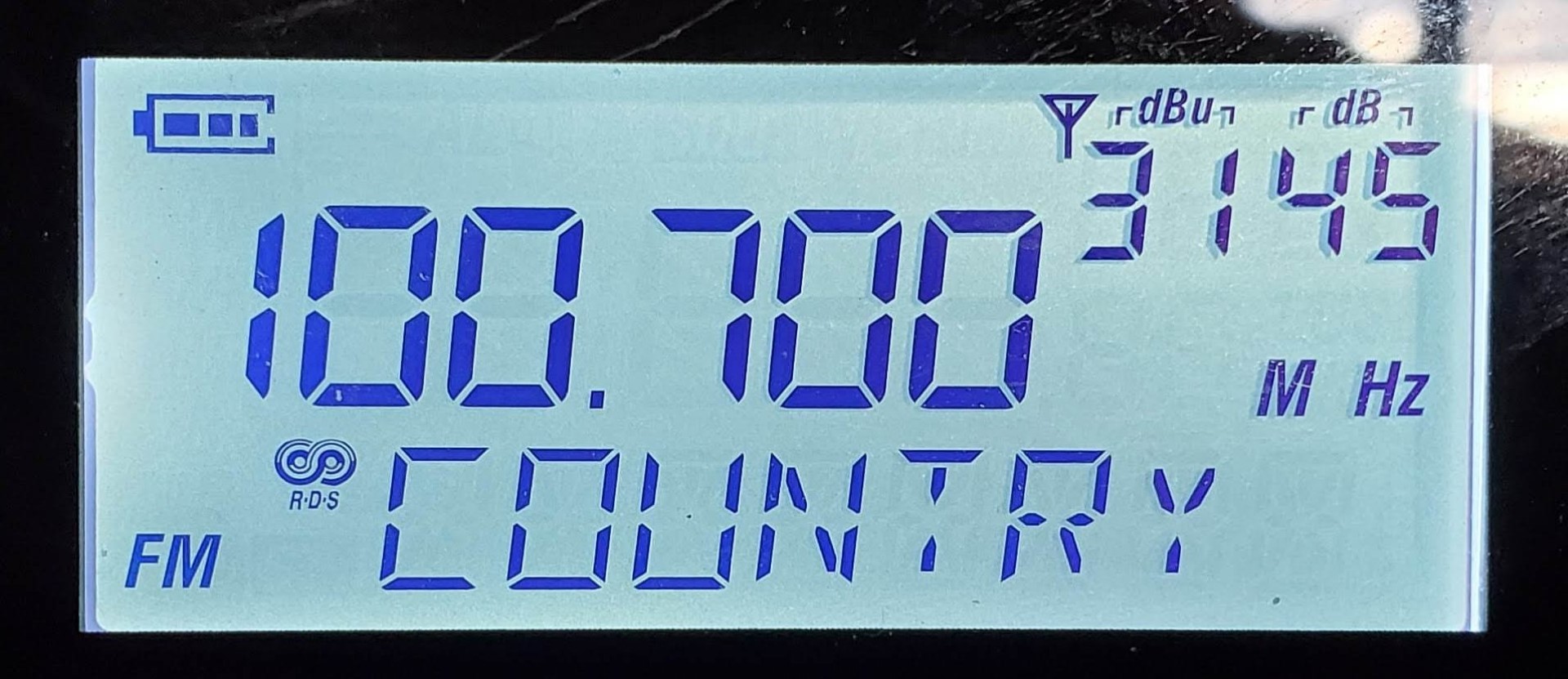
This presented me with a problem – since the SR-286 beats all my Five Star FM portables I decided to rate it with ***** 1/2 Stars to place it at the top of the ***** group. These are interesting results to say the least.
(Background) My car FM radio has always outperformed all of my portables. We have a Subaru Outback and a Nissan Altima and the Altima radio is far superior…I have no portables that can match it, so I took the SR-286 out to where the car was parked and the car radio was still better. It may have an even better automotive chip and it certainly has a more sophisticated antenna plus a great counterpoise (the car’s body), but still the SR-286 came closer to it than my other portables ever have. I suspect a better external antenna might close the gap as other users have suggested but I’m just guessing here.
The TEF-6686 chip has several enhancements as well such as multipath reduction, advanced blending in stereo mode, multiple bandwidths etc. How about 16 FM bandwidths including Automatic! While I consider this overkill there is no doubt that this radio will separate any receivable FM signal from any neighboring one or allow low distortion on typical signals. The Auto setting works well. There are also different FM processing settings…I found setting 1 (not the default) to be the best by a very slight margin.
AM Performance was also interesting. Because this is a compact radio the built-in ferrite rod is necessarily small and reception off the ferrite is consistent with the best radios of this size…it rates *** in the AM Mega Shootout list. However, you can select the whip antenna instead of the ferrite rod, and there is also a switchable 20 db amplifier you can enable. If you then take the radio to a very low noise area, such as outdoors, the AM reception becomes phenomenal rivalling my best Five Star reference radios. The only other limitation here is that you do not have the directional characteristics of the ferrite rod so some signals cannot be peaked or nulled by aiming which can be a big problem on some stations. But on others the downright sensitivity and low noise floor are phenomenal and sometimes even better than the ***** portables. This is truly outstanding performance.
Because the SX-286 is an Ultralight-sized radio the internal ferrite rod is necessarily small which limits its AM sensitivity to ***. Still the radio is as sensitive on AM as any other radio its size and better than most. However, I recently discovered that if you have a tuned passive loop like the Kaito AN-100 or Terk AM Advantage, you can connect it directly through the aux antenna input, enable the 20 db amp and achieve ***** AM performance even in indoors in noisier locations. I put this combination up against my ***** AM Reference radios and the SX-286 was fully their equal in this mode. No other portable radio performs this well in this mode because we are seeing the superiority of the TEFF automotive chip.
I didn’t have a chance to test the SR-286 on LW but have been advised that it is amazing on LW as well and beats the competition…I have no reason to doubt that claim.
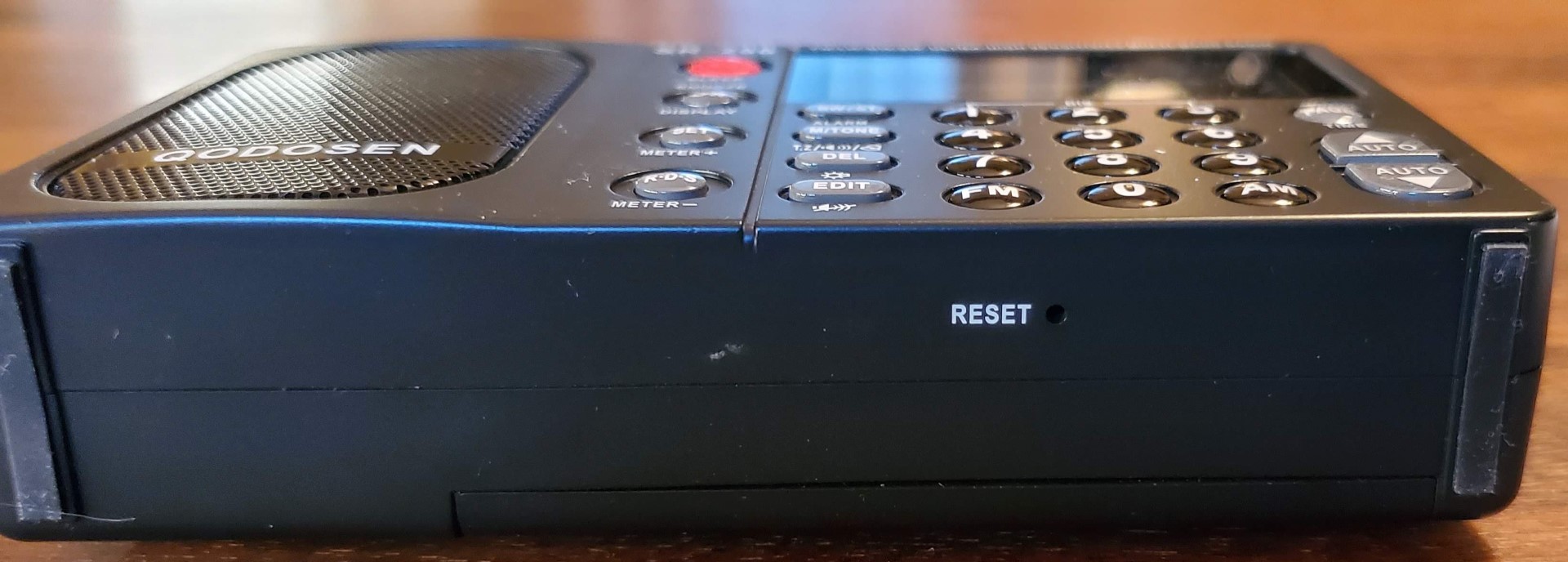
SW is also excellent even with the 19” whip but once again, the superb chip allows the radio to really shine when using external antennas. It loved my Wellbrook loop and a random wire antenna I tried with it and there was no FM breakthrough into the SW bands which we often find on less expensive radios. Using an antenna longer than the 19″ whip increases sensitivity even more. There is no SSB which is unfortunate but basic reception will not disappoint you.
Conclusion: I was completely unprepared for this level of performance and a feature set that goes way beyond what I would have even thought to wish for. I hope that one of the major manufacturers will realize there is market for radios with such performance. And although the many user settings are an incredible tool for serious radio hobbyists we must remember that car radios omit all of these arcane settings and instead use Automatic settings for simplified operation by anyone who can tune a radio. In a perfect world I would love to see a radio with this kind of reception, automatic modes which could be overridden by hobbyists or ignored by mainstream users, and a full sized portable with a ferrite rod large enough to extract superior AM performance in a typical home setting where the whip is too noisy to be practical. With a full size ferrite rod this could be very interesting. For now the radio is now listed at Ali Express:
Some readers have told me their radios arrived without the 18650 battery so you may have to source one seperately.
Update: SuperCharged Qodosen SR-286

Readers of the Ultralight Group are aware of Gary DeBock’s pioneering efforts with FSL antennas and loopstick modifications to Ultralight radios and none have garnered more interest than his latest efforts adding a large 7 ½” loopstick to the amazing Qodosen SR-286. The SR-286 may not be the last word in hard-core Trans-Atlantic or Trans-Pacific DXing due to its 3 KHz minimum AM bandwidth but other than that the radio has set new standards for reception in portable radios due to its use of the automotive NXP TEF-6686 DSP chip. In my main SR-286 review above I discuss all the details including ground-breaking FM reception and phenomenal AM sensitivity when you are outdoors using the whip antenna on AM …in short, this radio has amazed and delighted me and many others who have gotten one. But whip antennas don’t work well in today’s typical RFI noisy homes…in order to get the benefits of using a whip antenna on AM you must be in an extremely low noise environment, such as outdoors well away from buildings or utilities. For many people that means a trip to a park or in my case my backyard where the SR-286 shows amazing Five Star AM sensitivity off the whip, and that’s with a small 19” whip antenna. In my house, however, the whip is much too noisy so the internal ferrite rod antenna does a much better job. Not only do ferrite rods have the advantages of loop antennas in that they react to the magnetic portion of the signal rather than the electrical which inherently reduces noise, but ferrite rods have the added benefit of directionality so you can peak signals and minimize noise…two things you can’t do with the whip.
But because of the radio’s small size (in common with all Ultralight radios) it has a necessarily tiny 3 1/8” AM ferrite rod antenna. Even though the TEF-6686 chip has excellent sensitivity on all bands, AM reception with the tiny ferrite is only *** on AM, although that is as good as any Ultralight radio I’ve seen and better than most. So it’s no surprise that transplanting a big ferrite rod onto the SR-286 improves its AM reception considerably, and I must say that Gary’s work is technically excellent, requiring not only that he match the inductance of the larger ferrite and its windings to the original but also that he mechanically make it solid and reliable, and able to travel with a minimum risk of damage.

Gary graciously modified one of my SR-286’s and since I still also have a stock SR-286 this has allowed me to do several comparisons…I was interested to see exactly how well the modified SR-286 compares with other top performing AM radios I have on hand. While there is no doubt that the modified SR-286 will be much more sensitive than any stock Ultralight radio I wondered how it would compare with larger radios of undeniable reputation…radios which I rate as Five Stars on AM. For my tests I took three such radios…a Panasonic RF-2200, C. Crane CC-3 and a GE Superadio II out into the back yard along with several radios which I have rated from Three to Four and a Half Stars to see how well the modified SR-286 performs in that context. As is my customary method I scanned the AM band looking for signals of various strengths, ranging from some which were barely readable to some which were easily readable but hissy. (For these tests to be valid you have to have no electrical interference…RFI. The hiss I refer to is determined by the radio’s internal signal to noise ratio when receiving less than strong signals). I also used signals covering the entire AM band because sometimes a radio may be better on some frequencies than others. Because I end up using many radios on many signals it is necessary to log and tabulate the results to figure out the final rankings…this has proven to be reliable and repeatable over the years.

Results: Remembering that the stock SR-286 ranks *** on AM It was gratifying to see how well the Supercharged SR-286 performed…it ended up ranking **** ½ stars. Why not *****? There were several stations that the ***** radios pulled in with less background noise so I couldn’t rank the Qodosen as ***** on AM but it matched all the **** radios I compared it with and almost (but not quite) matched the **** ½ star radios I had available, which included a Tandberg TP41, Zenith Royal 755M and a Hacker RP-25 so the ranking was easy to determine. It was also interesting to note that switching between the 7 ½” ferrite rod and the whip the background noise usually improved, re-affirming the ***** rating on the whip, although there were two signals where the ferrite and whip were identical.

Above: Note Signal Strength Increases with Larger Ferrite Rod
AM Rankings:
Stock SR-286 with internal ferrite rod ***
Supercharged SR-286 ****
SR-286 with whip ***** (but only in very low noise locations)
Conclusion: One question which I wonder about is why the modified SR-286 does not attain *****. After all, the radio achieves ***** on its small 19” whip, and the 7 1/2” ferrite, which incidentally is beefier than the ferrite rods found in some of the ***** radios, should make it as good as the ***** radios. Why does it only make it to **** ? I don’t know. I suppose it is possible that some sort of reprogramming of the chip at the design level may make it more sensitive with the larger antenna, but again this is just a remote possibility. Certainly there are other variables which could account for it.

Nevertheless, Gary’s Supercharged SR-286 is an unqualified success. While it doesn’t quite match the very best full-sized ***** AM portables it is close and more compact which makes it more practical for travelling than the larger radios. The stock SR-286 is a great travel companion…the Supercharged version makes it even better.
I thank Gary for making one for me and you can bet that the next time I travel anywhere this will be the radio I take with me.
Qodosen – Where Did This New Company Come From?
I have been asked to provide some background information about Qodosen, a brand-new company which has produced one of the most astounding portable radios ever seen. Since their first radio (the SR-286 and the official release version DX-286 offered such breakthrough improvements in performance, many people may wonder where this company came from. Believe me…it did not come out of the blue!
I was lucky that a Chinese radio enthusiast sent me the first radio to evaluate and he also put me in touch with the radio’s designer, Mr. Deping Zeng. Since the Qodosen is such a remarkable design I think you will be interested in Mr. Zeng’s background…he has been responsible for more radio designs than you might imagine, and fortunately, Mr. Zeng has graciously provided me with a bit of history to share with you. Here is what he wrote to me:
“Dear Mr. Jay,
I’m happy to share my history in the broadcasting industry.
In my youth, I joined Tecsun in 1994 and left in 2005. I participated in designing many models, such as the Tecsun BCL-2000 (Grundig/Eton S350 DL). After leaving Tecsun, I founded Redsun Radio, focusing on R&D. The RP-2100, which I developed, was well-received and OEMed by many brands abroad, including CC Radio-SW, Kaito KA-2100, K-PO WR-2100, Silicon Scientific 75498, Roadstar TRA-2350, and ELTA 3569.
I worked at Redsun for five years. During my time there, I designed several products for C. Crane, such as the CC Radio-SW, CC-EP, CC-SWP, and CC-Solar Observer. I also collaborated with other brands like Toshiba, ELPA, and Digitech.
In 2009, I left REDSUN and founded a new company dedicated to OEM for various brands. I had in-depth collaborations with C. Crane and Eton, including models like Eton: S450-DXL, Elite Executive, Elite Field BT, Elite Traveler, Eton Mini Compact, FRX1, FRX2, and C. Crane: CC-FM Transmitter 2 & 3, CC-EP Pro, CC-Skywave, CC-Skywave SSB, CC Pocket, CC Solar, CC Pocket as well as XHDATA D-808/R-108 and Digitech AR-1780/AR-1748/AR-1945/AR-1733.
Now, I have established the Qodosen brand. Our first product is the DX-286 radio. Next, Qodosen will launch more radios with various functions.
I have been in the radio industry for 30 years and have always loved broadcasting, witnessing the changes in technology. Nowadays, with the prevalence of digital media and smartphones, the way people access information and entertainment is changing. Radio users are gradually decreasing, but I believe that radios will not disappear entirely. They still have unique advantages and space”.
So as it turns out we’ve been enjoying Mr. Zeng’s radio designs for a very long time and I think you will agree that his background in radio design speaks for itself…I look forward to future Qodoesn products!
 radiojayallen
You must be logged in to post a comment.