Panasonic R-1492
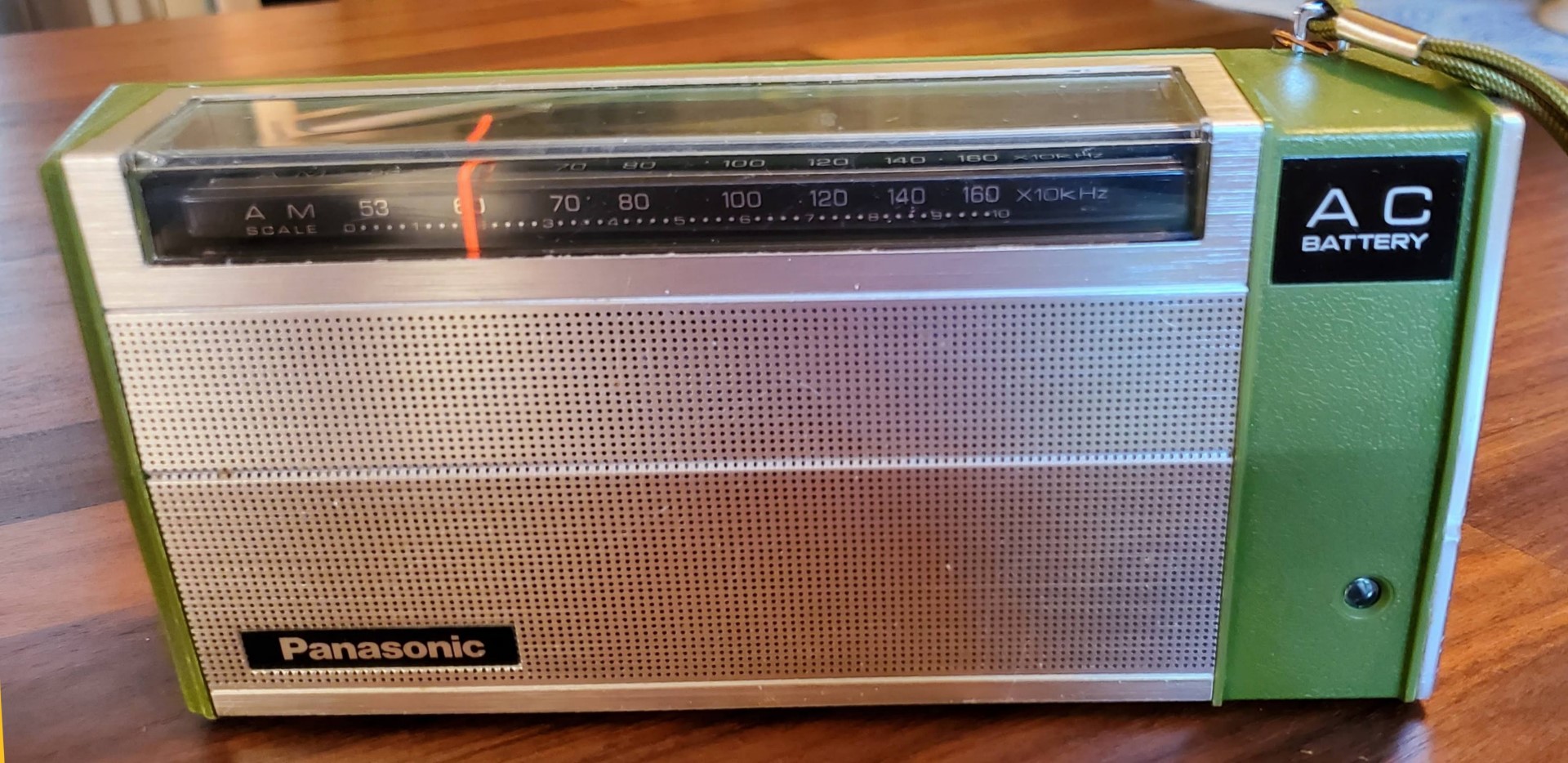
The Panasonic R-1492 (aka The Elmhurst) is an AM only analog portable radio from 1972. It is a simple 6 transistor design with a ceramic vari-cap tuning condenser but it has a 4 ½” ferrite rod of good cross-section. Available in Black, Red, Orange and Green it’s a great looking radio with a dual-faced tuning dial scale which can be viewed either from the front on the top…rather unusual. It runs on a standard 9-volt transistor radio battery or built-in AC Power which was a common feature back in the day. It measures approximately 6 ¾” x 3 1/3” x 1 ¾”. There is little information about it on line but I did manage to find an original Panasonic Service Manual for it. Unlike most service manuals it is a two-sided one sheet which provides a schematic, parts list and PCB layout but no alignment procedure which is odd. From the ads I found it appears to have sold for around $17 which seems like a bargain.
Checking It Out: After being interested in one of these for a while I finally found a pretty good looking green one at a fair price and soon it was in my hands. Checking eBay for several weeks I found many of these but many seemed overpriced.
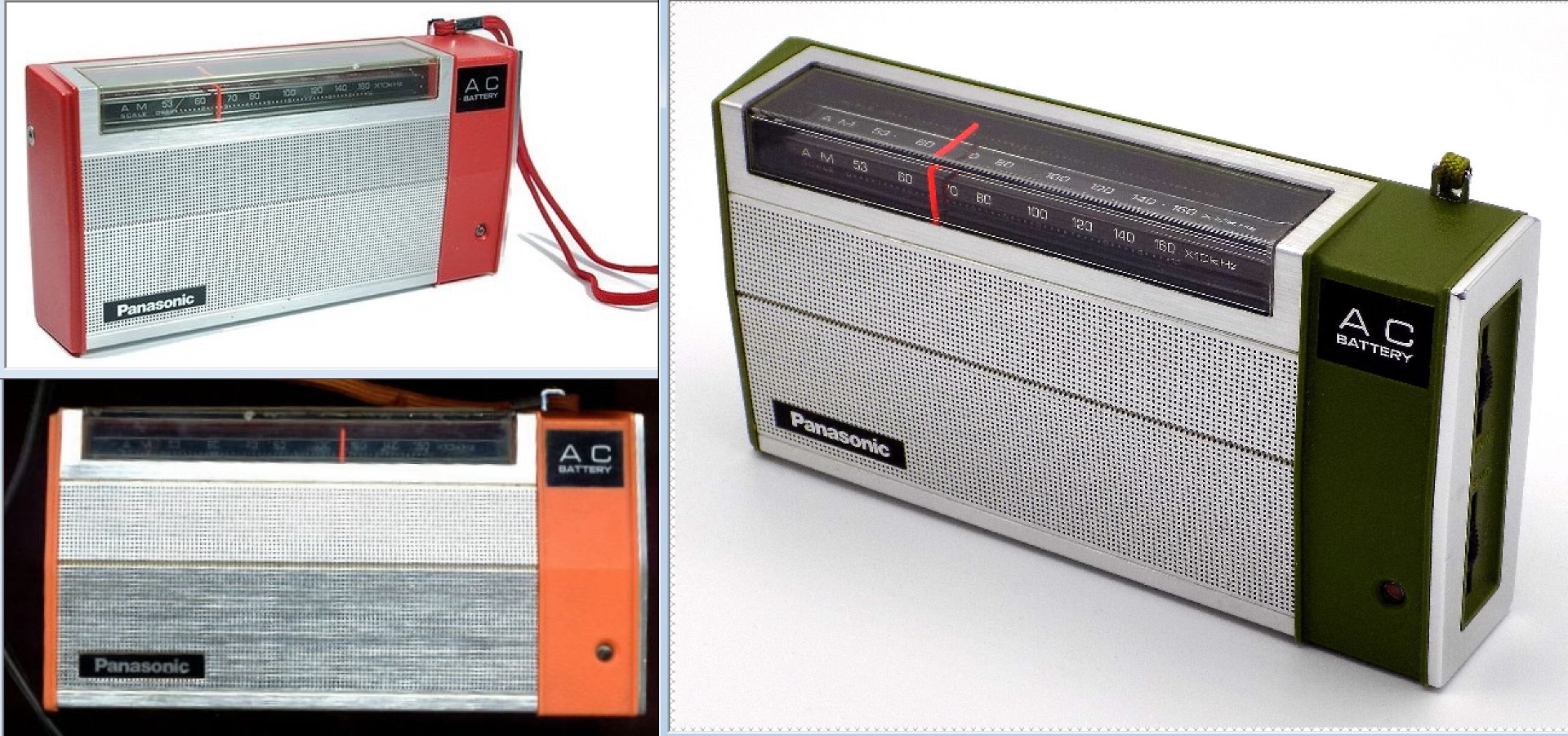
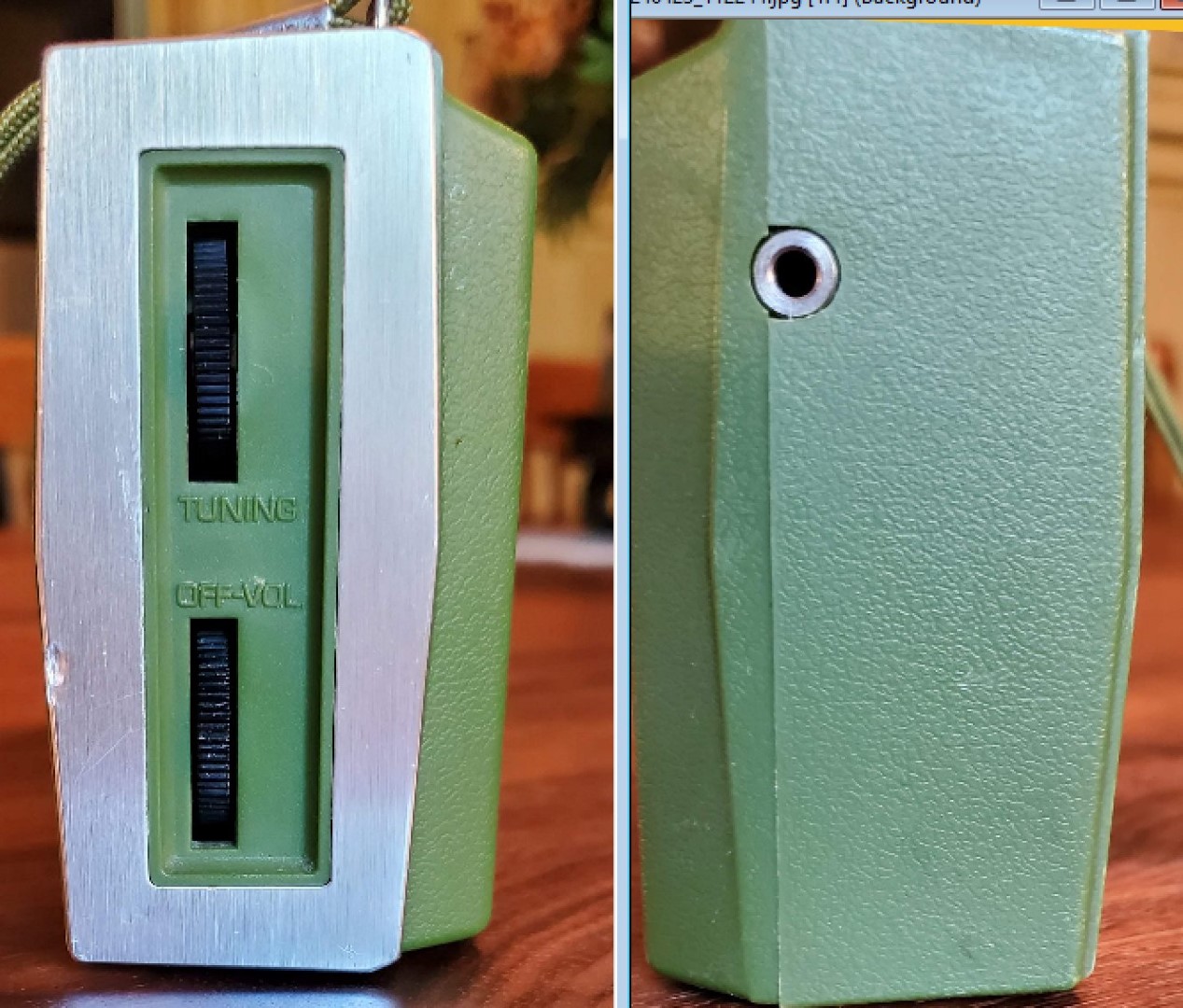
Besides the usual On/Off/Volume and Tuning thumbwheels the only other amenities are an Earphone jack, On/Off indicator and lanyard. That On/Off indicator is a shutter on the thumbwheel which covers a red marking on the thumbwheel when off…in some lighting conditions it’s not too obvious but hey, at these prices I didn’t expect an LED…at least not in 1972.
Something Strange: I noticed a small wire coming out of the top of the radio and hooked onto the lanyard clip…clearly an owner “modification” …more on that later. See below:

The only other thing I noticed was an extremely noisy volume control but a shot of De-Ox-It fixed that. I used a De-Ox-It Pinpoint Applicator and was able to inject a few drops into the rivet holes in the volume control pot…no mess! The electrolytic caps were all OK so there was no need to replace any of them.
When I started testing I felt its performance was not very good…in fact I had seen some online reviews describing the R-1492 as cute but not too sensitive or selective. I found that between stronger signals the radio was too quiet and weaker stations just weren’t there at all. I hoped an alignment would fix it and before I had the service manual, I had figured out the alignment points…as an AM only set that is not hard to do…there are only 7 adjustments including the L1 coil on the ferrite rod which is an important step.

The adjustable coil bobbin L1 is held in place by rubbery glue. I use a razor blade to slide along the rod toward the coil to remove as much as I can. Then, warming the coil and its remaining glue between my fingers I try to nudge it and rotate it slightly to free it up. Take care not to suddenly push the coil so far that its wires break…that’s not a good thing. Just steadily work it until it frees itself up. You can now adjust it and it will probably stay where you leave it but for good measure apply a drop of Loctite or other locking compound.
This radio was further out of alignment than I generally see… even the IFs were way out so I wasn’t surprised to see how much better the RF-1492 performed after adjustments…it was dramatically better. I suspect most R-1492’s would arrive closer to specs than mine did…this radio may have been previously tampered with…that modification I mentioned indicated someone had experimented with the radio in an apparent attempt to connect an external antenna to the radio. A well-intended mod which may have helped a little in some conditions but a far more effective way to add an external antenna input would be to wrap 3 or 4 turns of wire around the ferrite rod and use one end as a ground and the other to connect to an external antenna. This is a common method which many radios use and it works very well.
I was hoping that the Service Manual would have specific alignment details but it didn’t which is unusual. On the test bench the radio as received was tuning from 513 – 1690 KHz which is much wider than the manual’s stated limits of 525 – 1605 KHz, and the dial calibration was poor. I experimented with different top end limits between 1680 and 1620 and finally settled on 1640 for the top end and 525 at the bottom…this is lower than most AM radios tune but since the dial scale is calibrated down to 530 KHz and the manual specifies 525 that seemed to work. After the alignment I got a tremendous increase in sensitivity along with very good dial calibration. I think that by 1972 transistors had improved enough that this 6-transistor radio was performing better than I had expected. For perspective I put it against several portables to determine its AM Mega Shootout Ranking:
It was clearly between the 2 ½ and 3 Star radios so I had to call it 2 ¾ which is surprisingly good for a 6 transistor radio. Selectivity also improved after alignment and it is decent enough to allow most signals to be separated fairly well, although very strong signals do tend to spread out a bit more on the dial than on more sophisticated radios. It’s fine for general use though and all I could expect for this kind of radio…with average strength stations the signals were strong and clear.

Conclusion: The Panasonic R-1492 is a no-frills analog design and is a fun radio to play around with. I only have one of these radios and the one I got was further out of alignment than usual but I don’t know if this is typical or possibly due to previous adjustment attempts. Nevertheless, it aligned well and ended up with great dial calibration which is important for a radio with two nice dial scales. It’s not a boombox but sounds fine for casual listening and as an all-analog radio, band scanning is fun with it. The dual faced dial scale is very cool looking and the green color looks great on display but I’m sure it looks great in any of the four colors. The only caveat is that mine didn’t perform nearly this well until I aligned it so you should ask questions of a seller and make sure you can return one if it doesn’t measure up. But as an inexpensive vintage analog radio it’s lots of fun!
 radiojayallen
You must be logged in to post a comment.