Magnavox D 2935/Phillips D 2935

Above: Magnavox wiith faded faceplate – Philips As New (See Discussion)
The 1980’s was a period of rapid development in digital radios. Worldwide, Sony was among the most well-known manufacturers and their ICF-2001 introduced in 1981 and especially the later ICF-2010/ICF-2001D introduced in 1985 were hugely popular. Grundig and Zenith were well-known with their all-out designs, Sangean with many multiband portables and GE with their iconic AM/FM Superadios. Yet the Magnavox D 2935 (a rebadged Philips D 2935) was less well-known, at least here in the US.. Available between 1981 to 1989 it was described as a “travel-sized” portable to differentiate it from the desktop-designed yet internally similar model D 2999. At a hefty 7 pounds and measuring 12.5 x 7 x 3 inches it would hardly be considered to be a travel radio today since pocket portables have become so commonplace but the D 2935 represents a level of performance that is in some ways (not all) excellent. Before we get into a discussion of the high and low points of the D 2935 here are the basic specs and features.

Specifications & Features:

Manufactured in Hong Kong between 1981 – 1989
PLL Tuning
LW (146-521 kHz) – MW (522-1622 kHz) – SW 1623-29,999 kHz – FM 87.50-108 MHz (US Version)
Version 2 for Germany Limited to 26,100 kHz
Double Conversion
Single IF filter (See Discussion)
SSB with BFO Knob
Variable Gain Knob (In SSB Mode Only)
Tone Control knob
Local/DX switch 20 db (See Discussion)
Switch to select Internal Ferrite or Whip/External Antenna on LW/MW
5 Segment LED Signal Indicator (AM/LW/SW modes only)
Keypad for Direct Frequency Input
9 Memories
Tuning Knob (2 Speed 1K, 100K)
No Automatic Frequency Scan
RCA Line Out jack
¼” Headphone Jack (Mono)
Switchable Dial Lamp
Screw Antenna Terminals AM/FM with ground
Whip (39 ½” with Knob for 31” FM Length – very sturdy)
Carry Strap
Tilt Stand
4 1/2” Speaker/Sometimes quoted as 2 Watts but 1 Watt in the Service Manual
IF Frequencies: AM 55 MHz/468 kHz, FM 10.7 MHz
Power: 6 D Cells (50 Hour Life Claimed), 3 AA Cells (for memories)
12 Volt DC Input Jack Center Pin Negative
120/240 Volt AC Input jack (AC cord provided)
New Price: $180 – $290

Discussion: I’ve seen many multiband portable radios over the years but there are many more I’ve never seen and it is exciting when someone suggests one they think I should check out. As it happens two readers emailed me about this Magnavox within weeks of one another and one offered to loan me his radio to review…I’m so glad he did!
The D 2935 (and this article will refer to both the Magnavox and seemingly identical Philips D 2935) was an effort to produce a top-performing PLL-tuned radio to compete head with the best available from other manufacturers and I will say that they succeeded. Of course, being an early digital model, the D 2935 is not without its idiosyncrasies but in some cases it performs amazingly well. From what I learned in the service documentation and through online research there were minor circuit revisions along the way which is common, but the major revision was a reduction in the AM/SW IF bandwidth from 6.3 KHz to 2.7 KHz, and it appears this change was accompanied by a change from small gray Power and Light buttons to a larger Blue Power button and Gray Light button on the revised model.

Above: Early version wih small Power & Light Buttons
Back in the day the SW bands were very crowded and this bandwidth reduction was done to increase selectivity but it would be nice if the wider bandwidth were available today…one of the shortcomings of the radio is its fairly limited high frequency response on AM/SW. I think the lack of two bandwidths may be the biggest omission on this otherwise top performing radio. The audio is much more wideband on FM.
Speaking of FM, the whip antenna is 39 ½” but it has an enlarged ring which is used to pull the antenna out to 31” which is ideal for FM…this same system was used on many Grundig radios but oddly the owner’s manual says to extend it fully for FM…an oversight. The ferrite rod is approximately 8” long which makes for great sensitivity on AM and LW although I did not test it on LW.
Another issue with this model is that the faceplate usually degraded with time and perhaps with exposure to light…the result is that the front panel looks rather shabby but there is a replacement decal available on eBay which can be used to refresh the cosmetics…as this radio was on loan to me I didn’t try this but it looks like it should be relatively easy to do.

Above: Replacement Faceplate Decal available on eBay
The radio is supplied with an Owner’s Manual and a World Receiver Handbook not unlike the shortwave booklets Sony used to provide. The Owner’s manual is clear and well-organized and even outlines typical external antenna arrangements…very cool but unlike today’s radios the operation is so simple it is less necessary to study it. The World Receiver Book is a trip back in time and is of course outdated in some ways but contains a shortwave primer and more antenna information…it was a fun read.
Tuning: The keypad is not laid out in the standard format so it took some getting used to as the “0” is not in its usual spot…a minor quibble. It is not a light touch, requiring very firm button presses.
The two-speed tuning is not quite like similar arrangements I’ve seen on recent radios. If you tune at a normal speed it will increment in 1 KHz steps but with a few quick twists it will jump 100 KHz, not the usual 10 KHz. FM behaves similarly. It took some getting used to but after a while it became quite usable. There is no auto scan tuning.
The 9 memories are easy to use and there is a shortcut in their use. To explain, you have the choice of A, B and C groups and beneath each of those groups there is the choice of position 1, 2 and 3. If you select A/1 you can then press just the number 2 or 3 to go to A/2 or A/3…very quick and easy.
Other Controls: The Tone control is a bit unusual in that it not only cuts high frequencies as you rotate it CCW but if you turn it CW it will cut Bass.
The Aerial button lets you select between the internal ferrite rod or the whip or external antennas on AM/LW. Although not generally useful in the typical home, if you are in a very low noise location such as outdoors away from noise sources, the whip greatly increases sensitivity and reduces the noise floor. Indoors it has just the opposite effect. This is one of the relatively rare features of the D 2935. Interestingly, The DX/Local switch does not operate on AM/LW when using the ferrite rod…it does work when you select the Whip/External antenna. There is also a Variable Gain knob but it only works in SSB mode…another oddity.

Above: Aerial & DX/Local Switches, BFO Knob & Gain Control
Performance: I had mentioned earlier that the earliest version had an AM/SW 6.3 KHz IF filter but that was reduced to 2.7 KHz in later versions. This was done to improve selectivity in the days when the shortwave bands were very crowded but it does result in fairy rolled off high frequency response on AM and SW…its restricted audio bandwidth was clearly evident compared with the other radios. One mitigating factor is the tone control which can reduce the bass output as it is rotated towards fully clockwise…I found that by using it to slightly reduce the bass I could get somewhat better-balanced audio. I will say also that the sound is not as mufffled as you might think given the bandwidth spec and my best guess is that the filter has gradual slopes so there is more bandwidth slippng through than would be the case with a modern 2.7 KHz filter with steeper skirts. FM audio was more extended as you would expect…in fact the sound was very nice on FM.
As far as RF performance the D 2935 acquitted itself very well. I performed several comparisons with several familiar reference radios over the course of many days, both indoors under typical low to medium RFI conditions and outdoors with no RFI. Once again, this clearly demonstrated the necessity of comparing radios side-by-side on many frequencies and tabulating the results because the results on just a few frequencies can be very misleading. I performed tests both midday and, in the evening, using many reference radios including the Panasonic RF-2200, Sony ICF-2010, C. Crane CC-3, Sangean ATS-909X2, GE SR II, Zenith Royal 750M, Qodosen DX-286 and others.
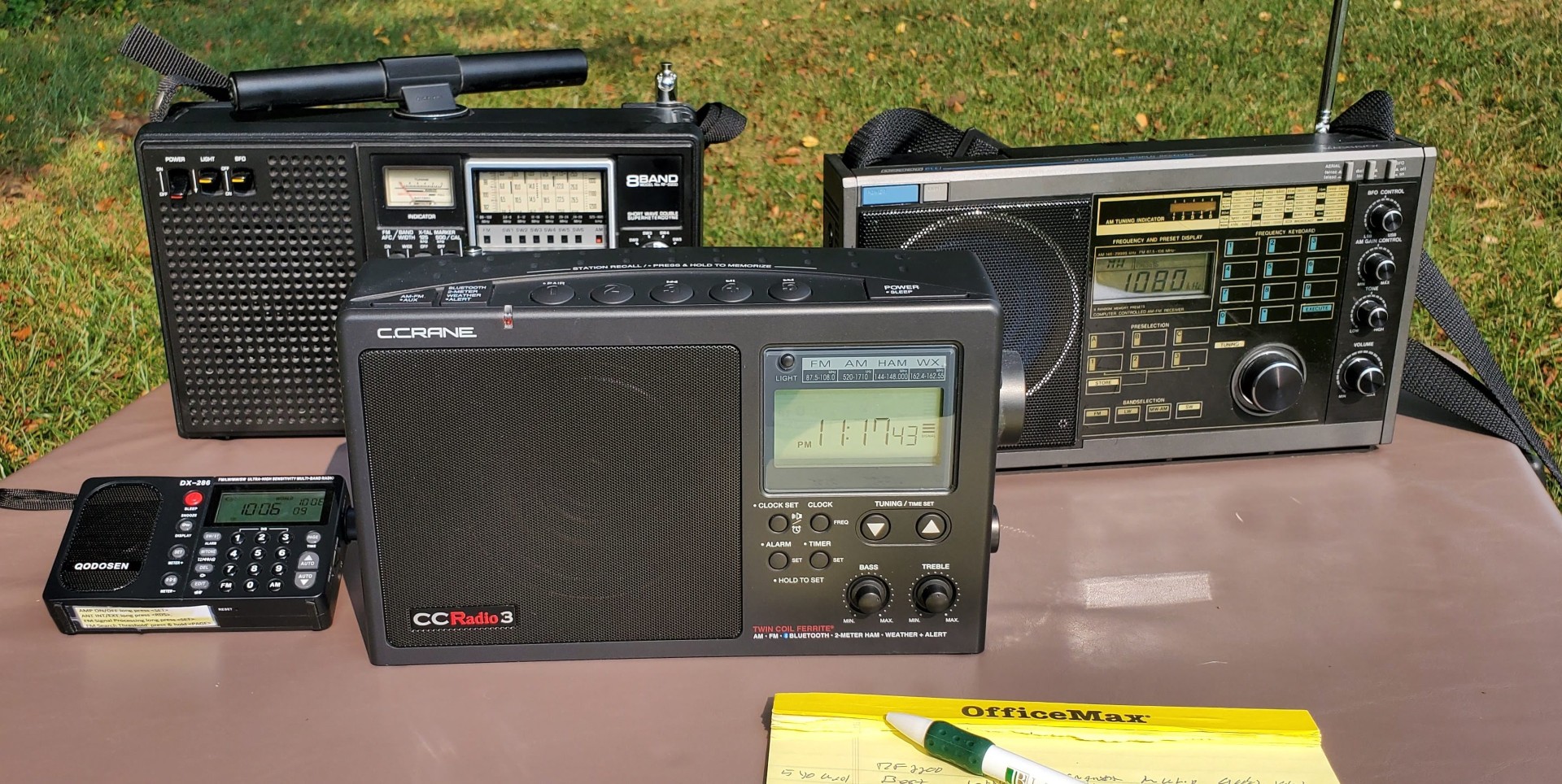
Above: One of several days in the backyard
Indoors on AM, using the ferrite rod the D 2935 ranked 4 Stars on the AM Mega Shootout List . It sometimes approached the Five Star radios but on several signals it was weaker with either lower volume or more noisy backgrounds. In my normal daily listening to average AM signals it seemed very good…only in carefully controlled comparisons was it noticeable that it was just a little less sensitive on AM. Additionally, Philips/Magnavox did an excellent job of shielding the digital and display circuits so there is no intrusion of digital noise on AM or SW even under the most revealing circumstances…it is as noise-free as the best analog receivers of the time…many early digital receivers fell down in this respect.

Above: 8″ Ferrite Rod and Shielded Enclosure
SW reception was excellent…the D 2935 ran with the best on shortwave and I could hear everything on it with the whip antenna that I could hear on any of my shortwave radios. It is clear that Philips/Magnavox were intent on creating a first-class SW portable. As a dual conversion design, I found no images but with external antennas it may be necessary to use the DX/Local switch if overload occurs. SSB seemed quite stable and I was able to use the BFO to achieve ECSS reception with natural audio recovery.
FM reception is not a strong point here. The IF Bandwidth on FM is very wide so the radio cannot separate closely spaced FM stations. This is quite common in many FM portables of the era but the D 2935 also suffers some FM images and desensitization in the presence of very strong FM signals. I don’t want to overplay this…the radio sounds very nice on FM and most of my usual stations came in just fine, but today’s DSP radios will far outperform it on FM. It ranks *** on FM.
The radio is slightly susceptible to overload on all bands under some signal conditions especially with external antennas…one review of the day recommended a pre-selector if a serious external antenna was used.
Outdoors on AM things changed noticeably and this is one area where the Magnavox was absolutely superb. AM sensitivity increases to a solid Five Stars, matching my best reference radios. As is always the case, there were a few frequencies where the D 2935 was inexplicably weaker than the others but there were two stations that were actually better on the Magnavox than on the reference radios. Overall, it was on a par with the best so if you have access to a low noise location the D 2935 will wow you. Incidentally, the service manual actually states that AM sensitivity will be better on the whip than the ferrite rod and that is exactly what I found.
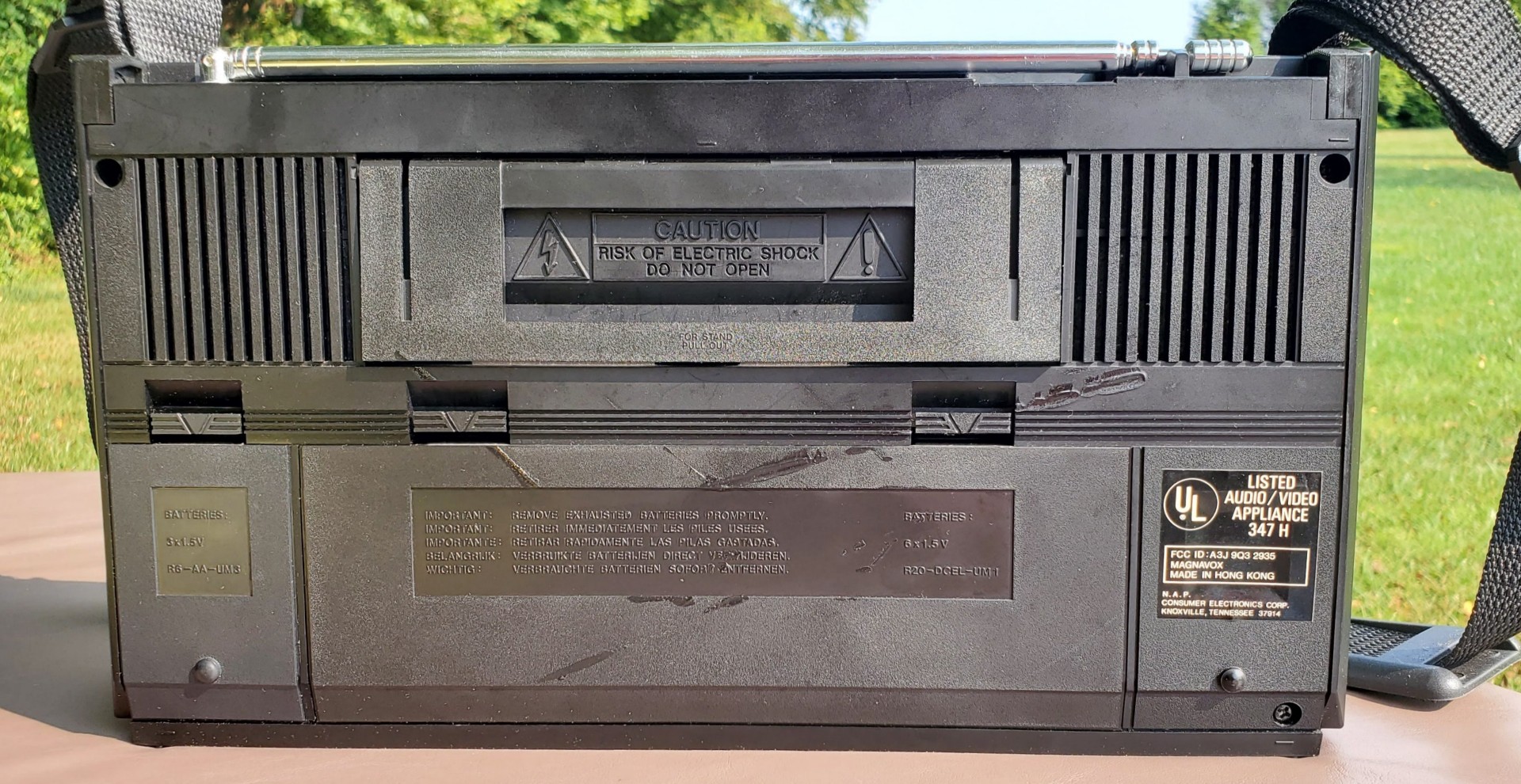
Conclusion: The Magnavox/Philips D 2935 is an impressive radio. It is not as well-known as the others I compared it with which means there is less information available about it online. For one thing it was expensive. I cannot absolutely verify its pricing but if it originally sold for $180 – $290 when introduced in 1981 that would translate to $640 – $900 in 2025…if those figures were exaggerated it may have been less but still it carried a top of the line price. Many people have claimed it is the best they have ever had while others have criticized some of its quirks but as is often the case the reality is somewhere in between. Overall, it certainly resides in the top tier of portable radios of its day with strengths and weaknesses ….stellar performance in some ways and merely good performance in others.
Key Takeaways: Biggest strength is excellent AM Sensitivity off the whip in low noise locations.
Good AM Sensitivity using the ferrite rod antenna.
Narrow IF Bandwidth on AM/SW (except on earliest version) gives slightly rolled off high frequency audio.
Excellent SW Sensitivity/Decent SSB/ECSS modes
FM suffers from poor selectivity but sound quality is very good.
Simple Operation but no Auto Scan Tuning
Extremely Sturdy Construction
Except for front panel degradation (which is remediable) my sample seemed to have held its original performance and alignment without deteriorating indicating very stable circuit design. AM/SW station tuning accuracy was within 1 KHz which is very good. Did not need recapping for example.
Overall a great radio and special thanks to reader Jeffrey Hoffman for loaning this radio to me for this review.
Recommended!
 radiojayallen
You must be logged in to post a comment.