GE P-990A World Monitor

The GE P-990A World Monitor was sold between 1964 and 1967, priced at $125 and is yet another fine example of heavy-duty, old-school design, featuring a massive steel chassis housed in a beautiful two-tone leather covered cabinet. It is simply beautiful to look at with an attractive multi-colored dial scale, another heavy radio from the time when weight meant quality and this GE is no exception. According to its designer, Conrad Jutson (who also was responsible for the popular P-780 series and several other projects), the P-990 World Monitor was GE’s answer to the Zenith Trans-oceanic. I presented Mr. Jutson’s extended comments about his design work at GE at the bottom of the P-780 article: – there are three documents there, but here is an excerpt which relates to his work on the P-990:
“My favorite radio would be the P990 multi band because it posed the biggest challenge. In order for it to be cost effective, our production methods would not allow for the traditional hand-wiring circuitry required for multi-band designs, so I had previously (for the P925) developed special components (switches, tuning capacitors, etc) that could be dip soldered.
Demand for short wave radios grew rapidly in the early 60’s (the Kennedy days) when US consumer interest in world affairs and news exploded and lower cost multi band radios from Japan were coming on the market. The P990 was one-third the retail price of the Zenith and Magnavox portables and a very good seller.”
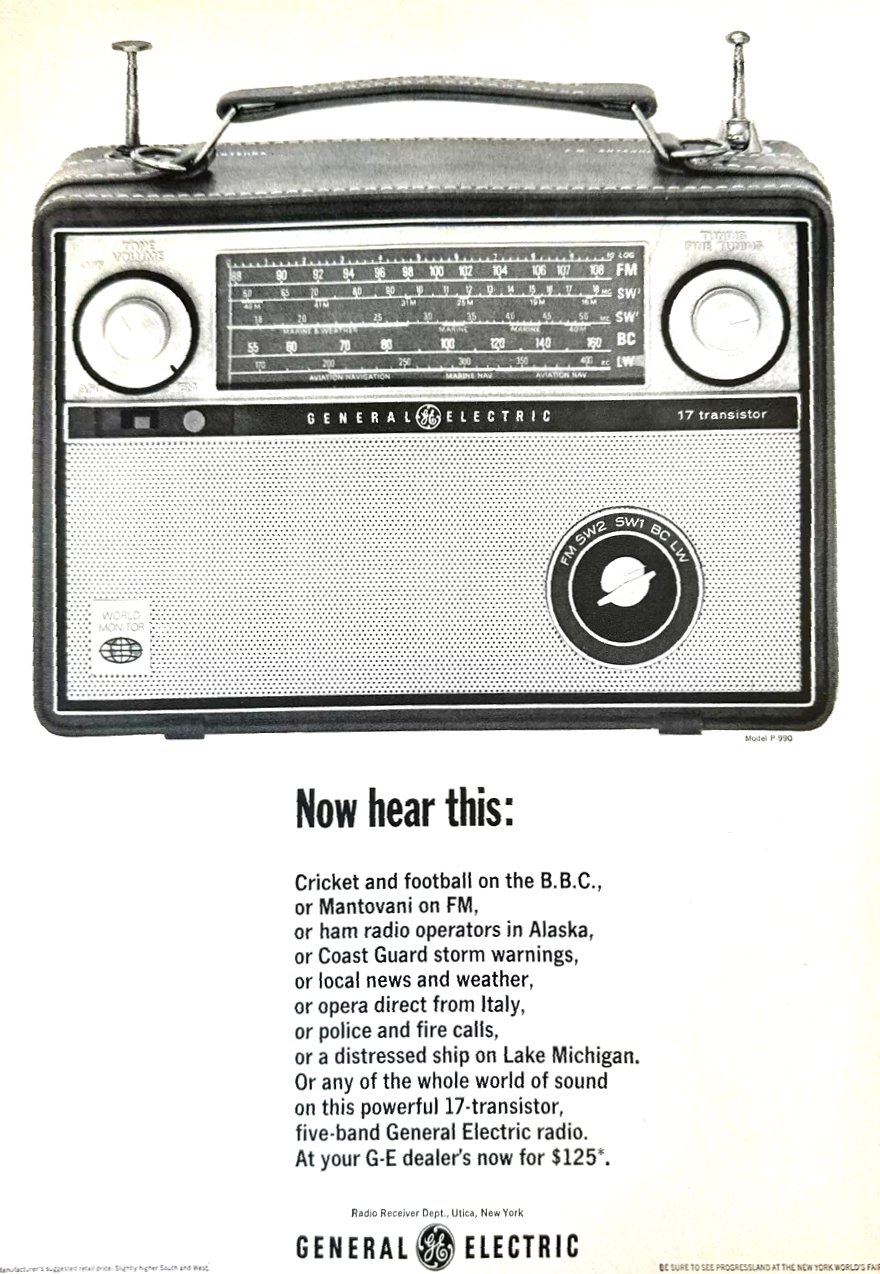
Unlike the earlier AM-only GE P-780, which was an all-out design developed to show how well a transistorized portable could perform compared with a 5 tube “All American Five” (and the P-780 actually outperforms those radios), the P-990 was not an all-out design. Mr. Jutson said the P-990 was one-third the price of the Zenith Trans-oceanic but that’s not quite true. Zenith’s Trans-oceanic Royal 3000 sold for about $275 while the GE P-990 was selling for $125, but that still means the GE sold for a bit less than half of the T/O. For an AM/FM/SW high quality portable radio the GE was clearly a great value. Yes, the Zenith was a more upscale design but the GE offers respectable performance within shouting distance of the Zenith. Remember, the GE’s 1964 price of $125 translates to approximately $1272 in 2025 while the Zenith’s price of $275 equals $2730 today. I can certainly understand why many people might opt for a more reasonably priced radio.

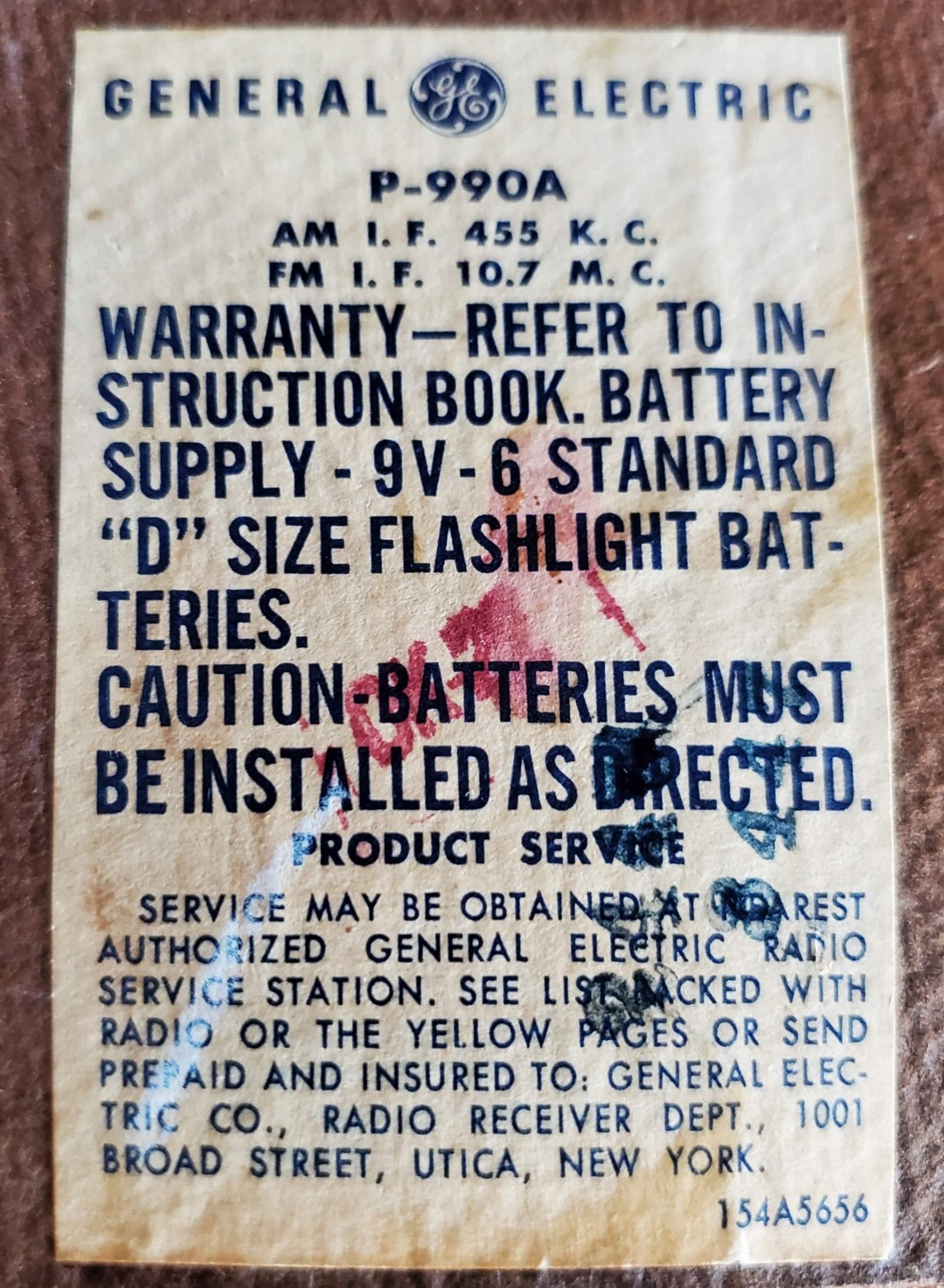
My radio is a late P-990A…the design of the log chart pouch on the back was slightly changed. On the earlier version the pouch snapped off completely…on the later sets it unsnaps at the top and hinges down still connected at the bottom…the opening to the battery box is behind it. There were also B and C updates but I don’t have much information on them other than that the B had a few minor circuit modifications with different transistors and a few resistor deletions. I suspect they would perform similarly. There is very little information about the P-990 on the internet but SAMS has the Service Manual for it so I was ready to get into it.

Specifications & Features:
Band Coverage: LW 170 – 400 KHz, AM 540 – 1620 KHz, SW 1.8 – 5.1 MHz and 6 – 18 MHz in two bands, FM from 88 – 108 MHz.
17-transistor all discreet design (no IC’s)
Power: 6 D cells or external 9 V input
Earphone out: 1/8: mono mini-jack
External SW/FM Antenna input (screws)
Controls: On/Off/Volume, Tone, Dial Light/ FM AFC On/Off, Band Selector, Tuning, Fine Tuning
Approx 7 ½” Ferrite Rod AM/LW Antenna
Two Whip Antennas: SW 56”, FM 30 ½”
4” speaker

There is a pouch on the back which holds the log book and under it is the opening for the battery box. Putting the batteries in requires some attention to wiggle them into position in the correct order…otherwise you can’t get them all to slide in.

The output transistors had been replaced many years ago but the controls were always a bit problematic and this radio then sat unused for several years so it had developed extremely erratic and noisy controls which were all restored using De-Ox-It. and the De-Ox-It Pinpoint Applicator which I have found indispensable in such situations:
Prior to cleaning all bands except FM were totally dead and FM was completely erratic, but cleaning restored all of the controls 100%. When cleaning the band switch, I used the pinpoint applicator to keep the De-Ox-It from getting all over the many small components surrounding it.
Alignment seemed fairly close but I always go through that process to be sure the radio is working as well as it possibly can and there were incremental improvements here and there with no surprises. As is common with radios of this era some of the FM calibrations are very touchy, involving slightly compressing or stretching a coiled inductor and bending plates on the FM tuning gang. Very slight changes have a huge effect so you have to make the adjustment then let go and see where the adjustment ends up…trial and error until it ends up right. Not as bad as it sounds and you do get the feel of it if you’ve done this type of adjustment before.
Performance: OK. The P-990 is not one of GE’s top performing radios but nevertheless it has good performance and is very well made…a heavy, rugged and beautiful design in its two-tone leather case.
AM ranks *** on the AM Mega Shootout which means it is good enough to bring in your usual AM stations well. It does not compete on extremely faint signals with the most sensitive radios but is pretty close to the AM we get on most world band portables.
FM ranks **** on the FM Mega Shootout which is typical of early portable radios…it is reasonably sensitive but not as selective as today’s radios so it pulls in weak signals OK but has some difficulty separating closely spaced signals on a crowded FM dial. The separate swiveling FM antenna is approximately 31” and is tuned properly for FM wavelengths.
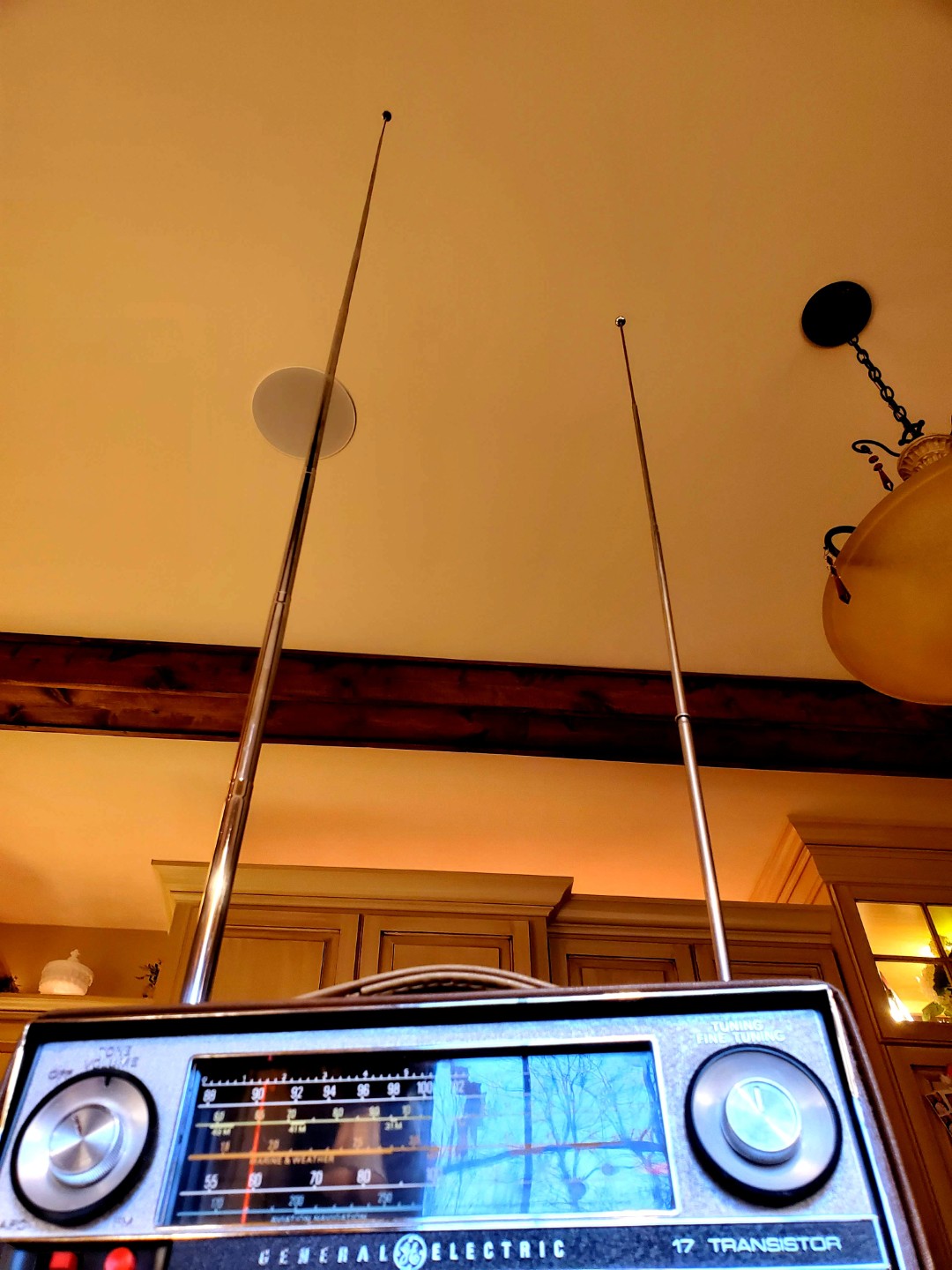

Above: Separate FM/SW Antennas – Huge 58″ SW Antenna
SW is also fairly sensitive and the towering 58” whip antenna helps. In fact, that antenna is so huge it comes close to reaching the ceiling in some locations…it is very impressive. The Fine Tune knob is essential on SW because SW tuning is a bit touchy given how much frequency range is covered in each SW band but fine tuning makes zeroing in easy. There is a bit of hand capacitance effect when tuning on the higher SW frequencies…that is to say, sometimes the frequency will change slightly after you let go of the tuning knob. Not surprisingly this seems not to happen if you’re holding onto the radio as you tune it and it seems that GE should have been able to correct this.
Sound is well balanced and powerful. The 4” speaker in a large box can fill a room easily and the variable Tone control is a nice feature.
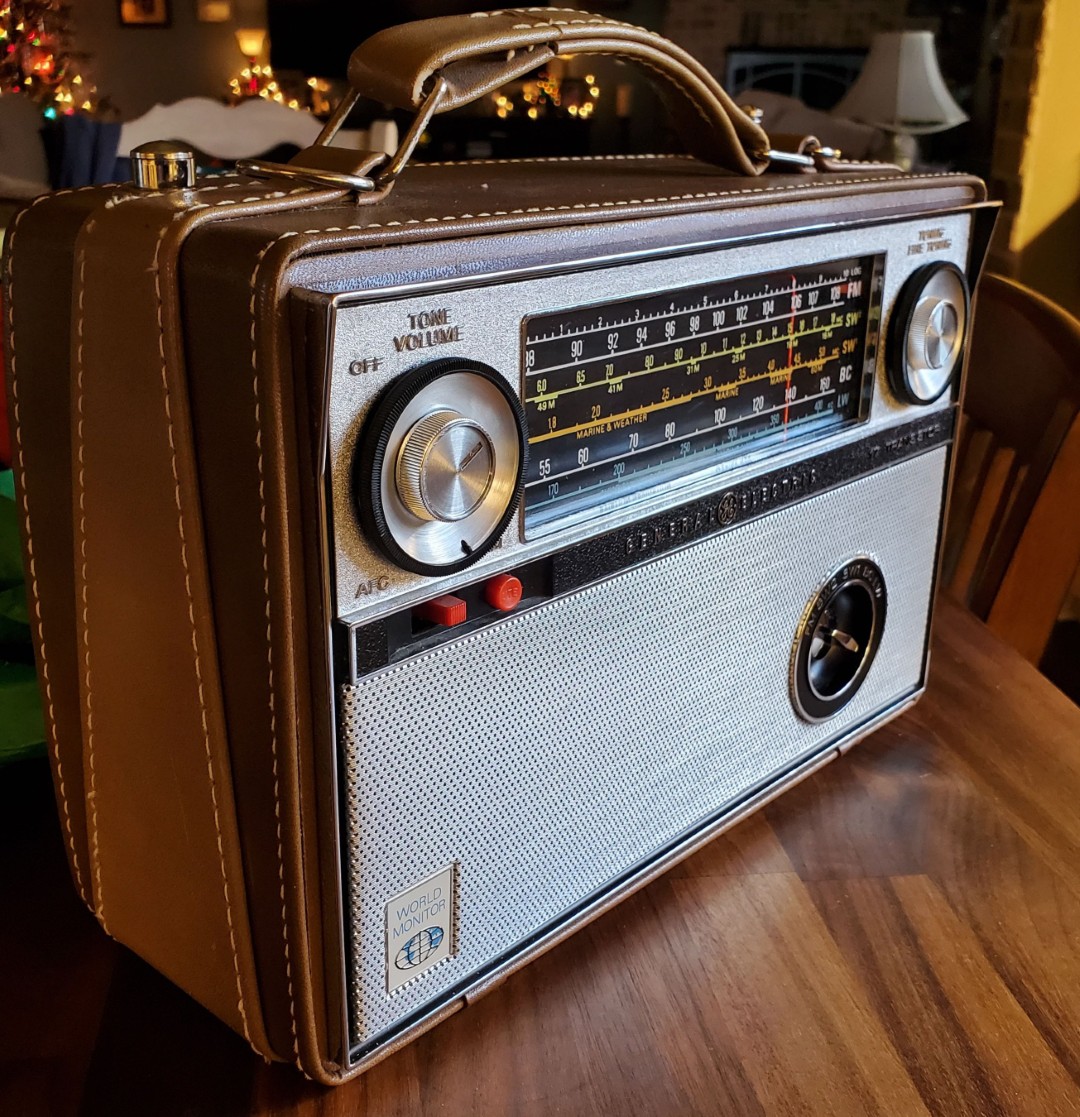
Conclusion: According to its designer the GE P-990 was designed to compete with Zenith and Magnavox radios but to sell at a much lower price. Naturally this had to involve some compromises and on a direct comparison with a radio like the Zenith Trans-oceanic Royal 3000 one can see where those compromises came into play. For example, the Zenith has several spread bands which make SW tuning more accurate and easier and is slightly more sensitive on SW. Also, the hand capacitance effect while tuning on SW should have been addressed. (It may have been in the later B and C versions…I don’t know). But overall, it’s hard to fault the GE P-990 because it offered a lot of radio for the money… a solid all-analog design, handsome and fun to band scan with. It’s a nice addition to my collection.
 radiojayallen
You must be logged in to post a comment.