GE P-840/P-875 AM Radios
(and how I forgot to always check the simplest things first).

Released in 1962 or 1963 the General Electric P-840/P-875 are the apparent successors to GE’s ground-breaking, tour de force P-780 series of portable AM radios. Interestingly, although the P-840 and P-875 radios look identical and share virtually identical chassis, the P-840 is an 8-transistor design while the P-875 uses 7 transistors. The P-840 has a two-transistor audio driver stage while the P-875 uses a single transistor audio driver. Since they seem to have been available at about the same time it is possible it was just a circuit revision… possibly a cost saving change. Other than this the two models are almost identical. These radios are about two thirds the size and weight of the P-780 series but still share many of the former’s design concepts; heavy steal chassis, beefy speaker, large ferrite rod, tuned RF stage, three gang air variable tuning condenser…even the dial light switch is identical. There is a long 7 ½” ferrite rod antenna and the radio is powered by 6 C cells which will give long battery life. In addition to the usual On/Off Volume and Tuning knobs there is a variable Tone control and a push button Dial light. The grille is chrome plated and is very heavy and impressive. I had read some glowing reports about these radios that described them as top performers so I was eager to learn more about them. I will discuss both of these models as one since they are identical in every respect other than the difference in the audio driver stage which I will address later.

As Received: My radios both arrived in poor condition…the Brown P-840B was dead and the Black P-875A was weak so the first thing I had to do was to try to get them working properly. Cosmetically they cleaned up fairly well…one cosmetic flaw that cannot be corrected is the clear plastic tuning dials which had yellowed – one was much worse than the other. This is a common problem with old radios and there is no remedy I am aware of for it. I have read of a few that never worked for me. Also, there were some missing chrome dial inserts. I later got a parts set to replace them. They impressed me as heavy and solid…as they say, “They don’t make ‘em like they used to”.
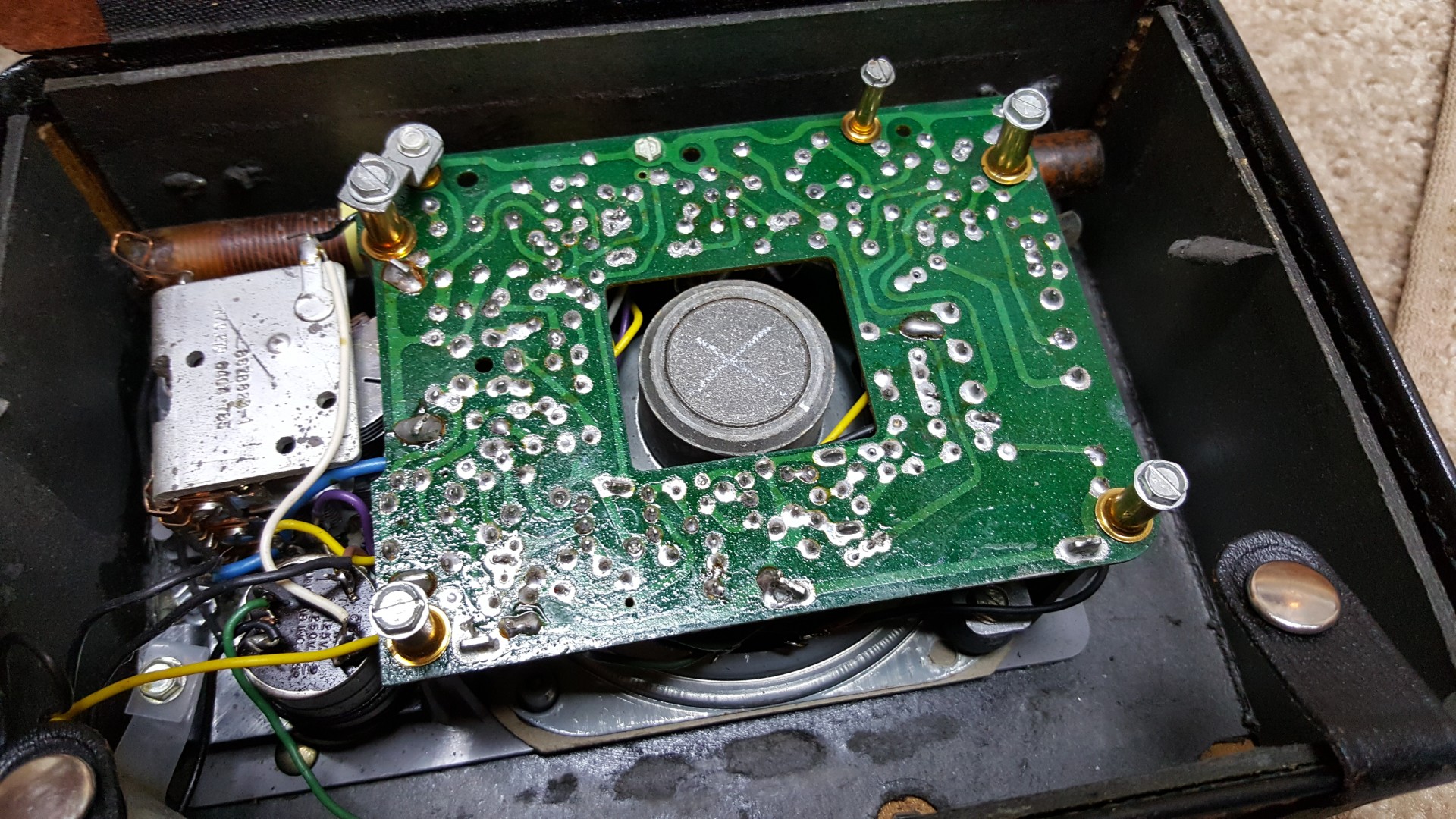
Removing the chassis was simple enough…it is secured by several large screws with unusual shoulder spacers…I’m not sure what purpose these odd spacers served as opposed to just using shorter screws. Looking at the above picture you can see there are two sizes of screws…you only need to remove the ¼” Hex head screws…the smaller ones should be left alone as they secure the ferrite rod to the board. I replaced all of the electrolytics on both sets, some of which had obviously swelled and others which tested bad…but the P-875 still had a bad static issue which turned out to have two causes.
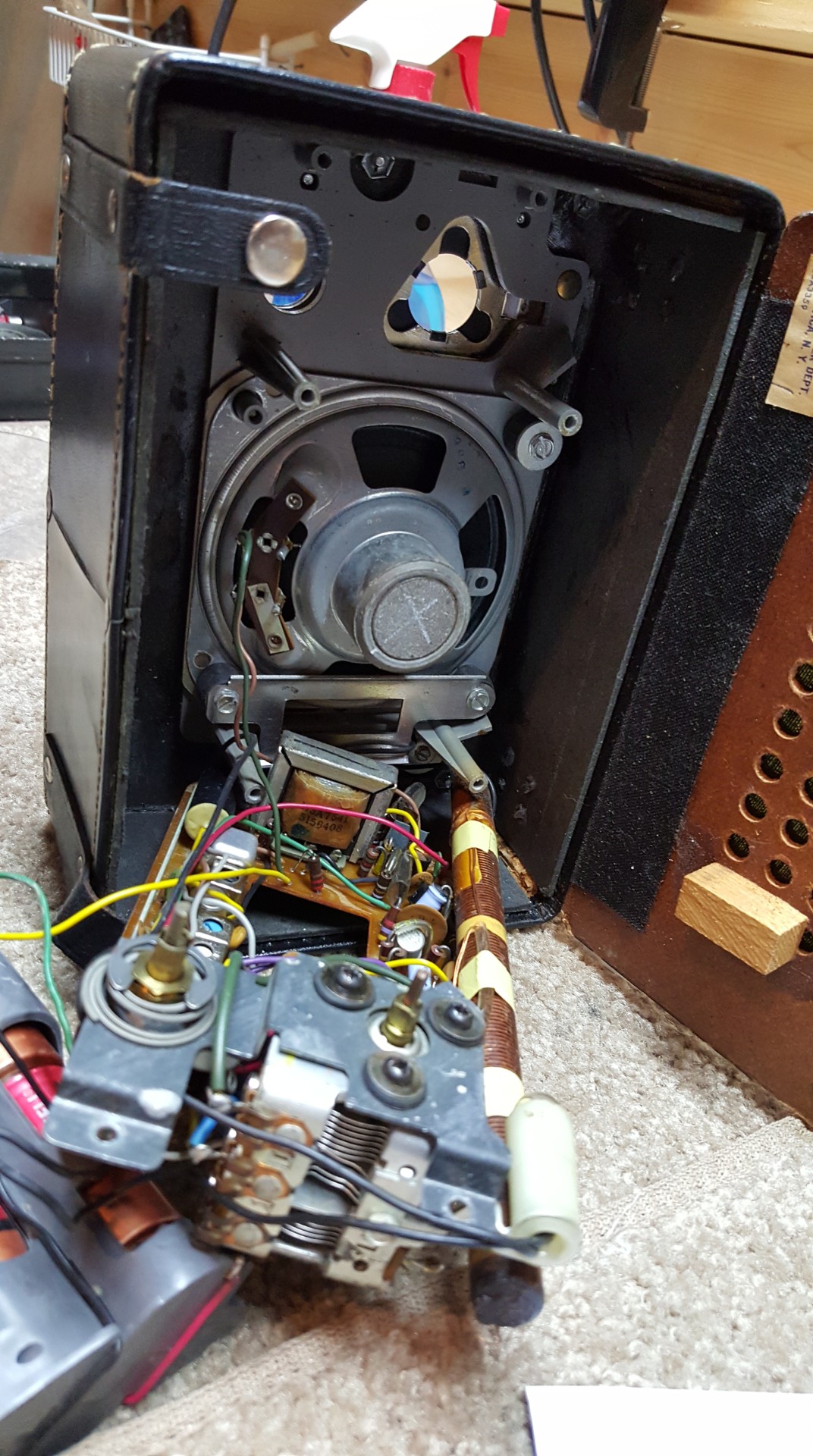

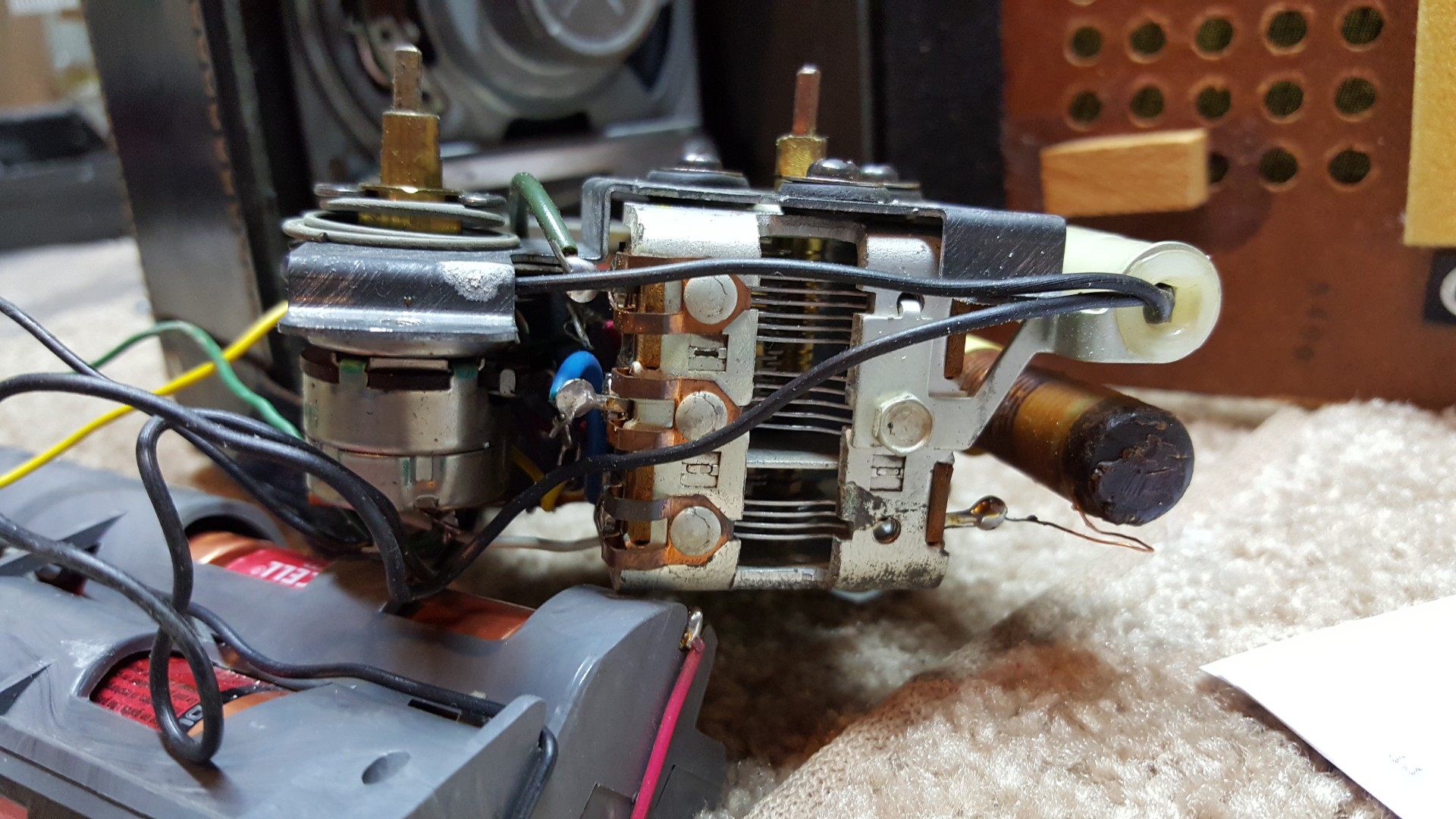
The worst problem with that set was the tuning gang itself. It was so bad I feared it had shorting plates because tuning was extremely erratic and there were dead spots. If the gang was shorted beyond repair it would be the end of the radio. I used compressed air to blow it out and although it improved somewhat it was still noisy and erratic. That was cured by my old trick of soaking the plates with 91% isopropyl alcohol then blowing it out with compressed air which I repeated a second time for good measure, then treating the contact bearings with De-Ox-IT…it was a relief that it now tuned properly with no noise or dead spots. (Note that after the alcohol & compressed air treatment it takes several minutes for trace amounts of residual alcohol to evaporate completely before everything settles back to normal operation).
The other issue was elusive at first…bursts of static that seemed to accompany the audio if the radio was played loudly or if it was even just handled but which didn’t seem to occur when the unit was disassembled making it difficult to troubleshoot. That turned out to be nothing more than a cold solder connection right on the battery box. These radios use a center-tap connection on the battery box to individually power the two halves of the push-pull output stage…when one connection dropped out one of the output transistors lost power. I also disassembled and cleaned the light switch contacts…this is a crude design (identical to that used on the P780) and any resistance in its contact points will make it finicky.

This is about as rotton as any battery box I’ve seen – yet it was fixable
I had bigger problems with the P-840B which started with a badly rusted battery box. With this amount of damage, I would normally discard the box and replace it with a generic battery holder but this one was screwed together and could be completely disassembled and the metal contacts removed as well. I took this as a challenge to see if I could make it work again, so I soaked the springs and flat contacts in Rust-o-leum Rust Remover overnight. The next day I was able to wipe away lots of rust but they still looked pretty cruddy so I ended up finishing them off with small files and fine sandpaper. I’ve also got to admit that although I took pictures during the disassembly it was still confusing to get it re-assembled and wired correctly…my pictures were not detailed enough. With several connecting points it was not as simple as you might expect. What saved me was having a second radio to use as a guide…another lesson learned. It was also recapped.
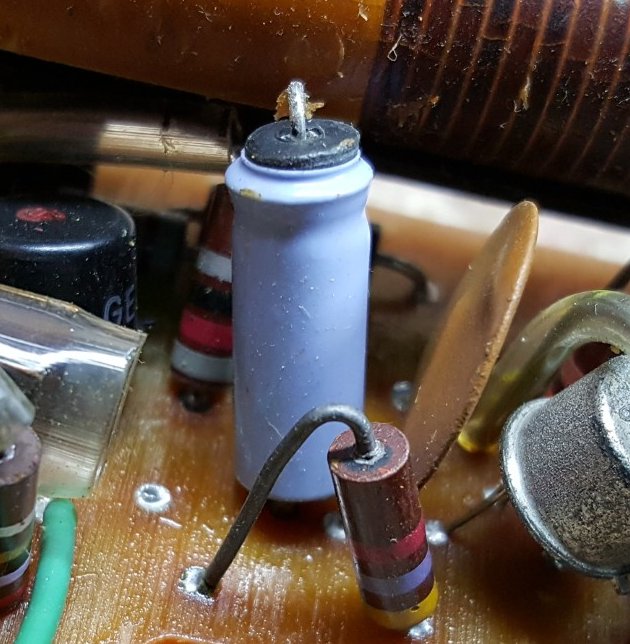
Above: Bulging Electrolytic Cap has obviously failed
But a bigger problem remained and it demonstrates a lesson I learned long ago but evidently forgot while trying to fix this radio. The radio had a low-level distortion but if the volume was turned up at all there were loud bursts of noise…very loud static. Since the crackling seemed related to output level, I first suspected the output stage but everything checked out. The transistors seemed OK and all the voltages were in spec. Stranger still, when I started to trace the audio backwards through the output stage to the driver stage and even way back into the IF the crackling was still there when the volume was advanced. This of course made absolutely no sense…how could volume-dependent crackling in the output stage be heard even in the IF stages before the audio detector? I thought about this for a few days and in exasperation I sent the chassis to an engineer friend of mine to look at and when he did he reported the radio was playing fine and in fact sounded great when connected to a nice speaker! At that moment the truth hit me like a ton of bricks…the problem could be a bad speaker…I had sent him only the chassis to check. I then checked that speaker and sure enough it was bad. It hadn’t occurred to me that the speaker could be the culprit because of its unusual symptoms. Evidently the voice coil was shorting out when driven and that electrical disruption was being reflected back throughout the entire circuit which explains why I heard the crackling at every stage I tested. I must admit I felt a little silly because I had forgotten to check for the simplest things first…a lesson re-learned!
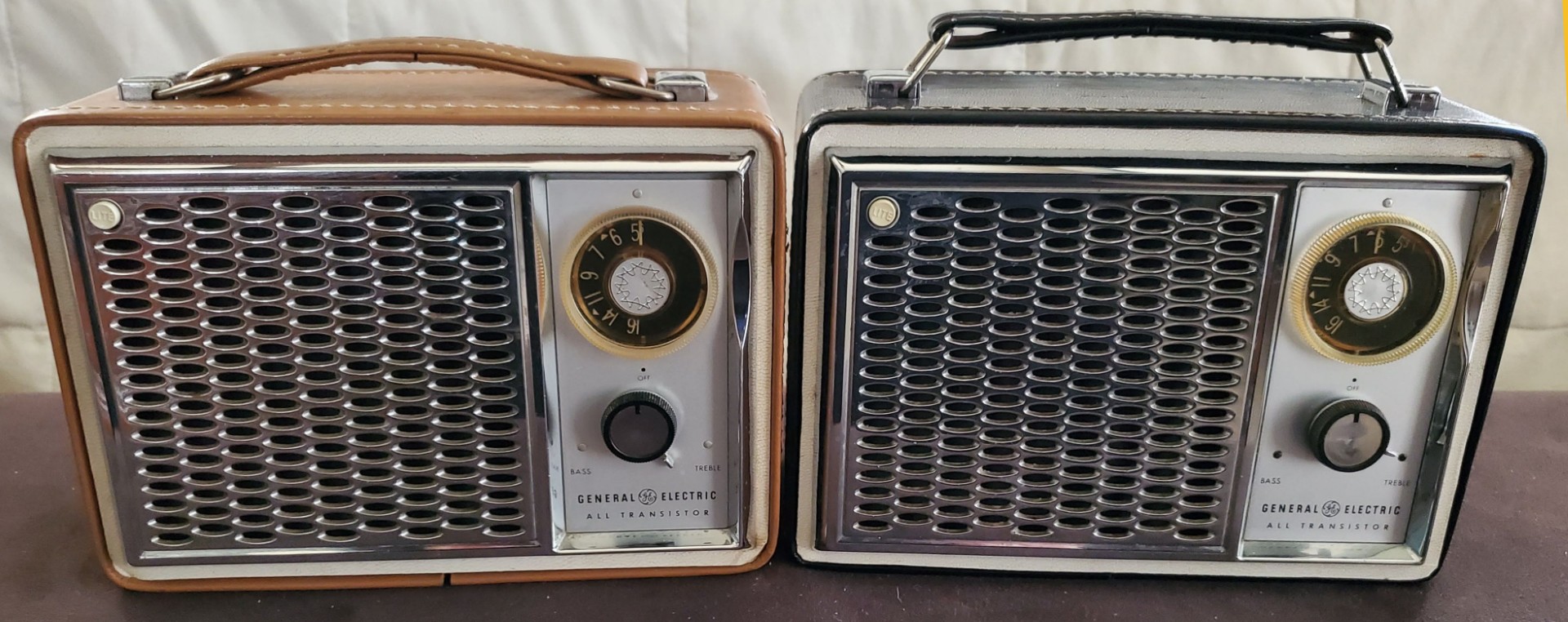
Performance: I finally had the two radios repaired and aligned for best performance and it was time to compare them and I will say the results aren’t quite what I expected. Since the P-840 has that two-transistor audio driver stage compared with the P-875’s single transistor design I was looking for sound differences but that’s not what I found. What I DID find was a very subtle difference in RF performance with the P-840 just a very slight bit more sensitive to weak signals at the bottom of the AM band although they were pretty equal at the top end of the band. I don’t want to overstate this as you would have to compare the two radios side-by-side to even notice the difference, but on weaker signals the reception was just a bit clearer with less hiss on the P-840. I also checked for audio differences on stronger signals and there were none. The two radios share virtually identical RF/IF stages…this tells me that the most likely cause of any differences in RF performance are likely to be unit-to-unit variations which is very common in old radios rather than circuit differences.

Left: P-780H Right: P-840
Since the P-840 and P-875 replaced P-780 and the later P-873/784 Musaphonic series, and based on what I had read, I expected them to be roughly equal in performance even though they are smaller radios. I found however that reception didn’t quite match my P-780’s…weaker signals were just a bit clearer and had more reserve volume on the P-780. The P-780 ranks **** and the P-840/P-875 will rank *** ½ on the AM Mega list. There was also a noticeable difference in sound quality. The P-875/P-840 are fine sounding radios, but put them side by side with a larger P-780 and the P-780 easily wins…it just sounds larger and richer…more bass…more treble…just better. Again, I’m not saying you can’t enjoy the sound of the P-875/P-840…they do sound very good…and better than many modern radios – they just don’t match the obviously bigger, stronger audio of the P-780 or especially the later Superadios.
What about the extra audio driver transistor on the P-875? To restate my findings,I didn’t detect any audio difference whatsoever. Most likely the circuit was tweaked to achieve the overall same gain/noise performance without the extra transistor…if there are any differences, they are too small to detect.

Conclusion: The GE P-875/P-840 are nice, heavy, solid radios and if you love old analog radios as I do you will like them. Being all analog and with a good circuit design they are excellent band scanners and will resist overload in extremely strong signal areas where many modern radios are overwhelmed. And even though weak to medium daytime signals will be a bit noisier than on higher rated radios the overall RF performance is very good. At *** 1/2 stars I feel these are good performers overall and, as models which bridged the time gap between the P-780 which truly broke new ground in AM portable radio performance in the late 1950’s, to the legendary Superadio I and II of the 70’s and 80’s, the P-875/P-840 are radios I’m glad to have in my collection.
 radiojayallen
You must be logged in to post a comment.