Blast From the Past
A Look at 5 Vintage Digital Portables
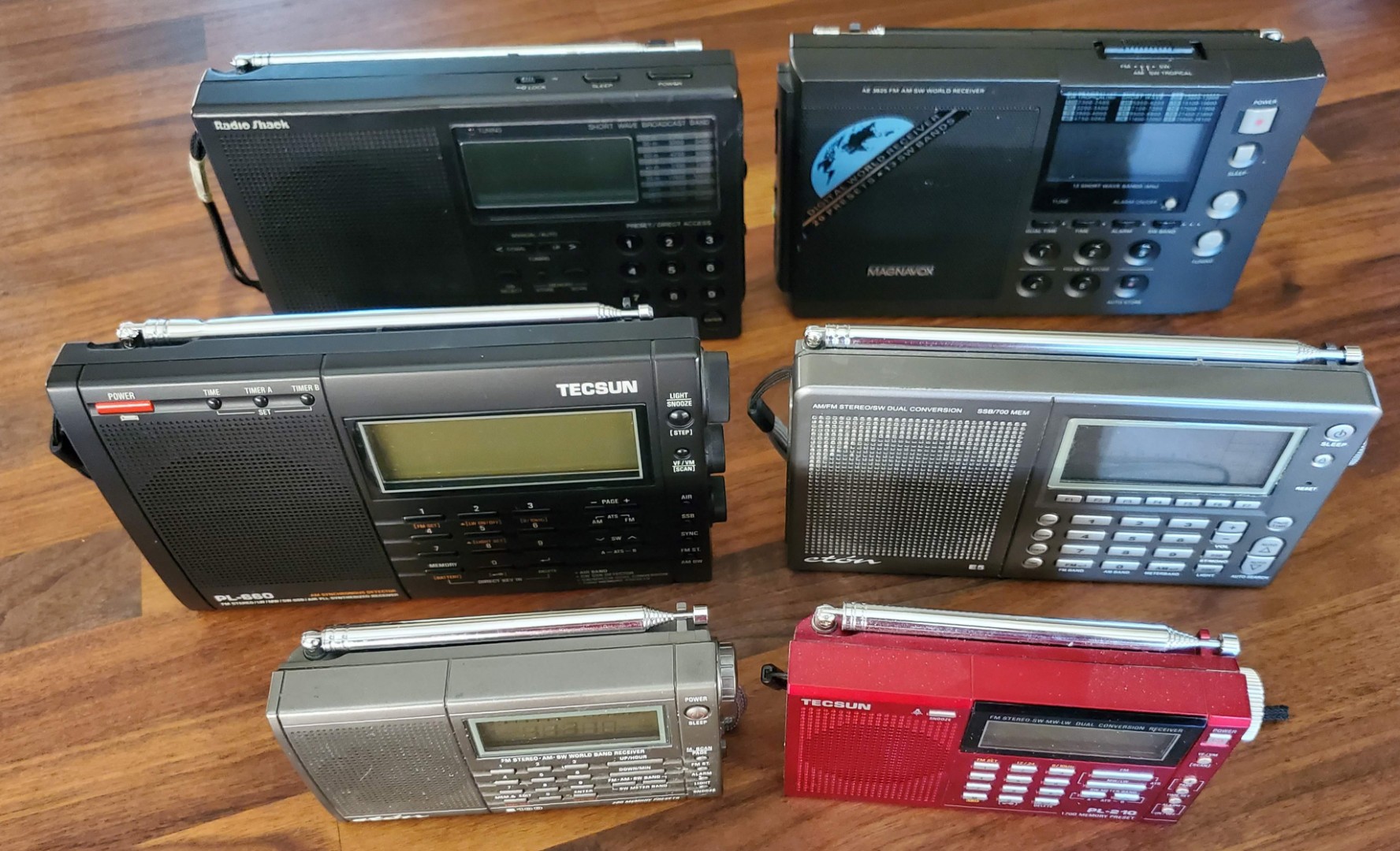
Left Rear: Radio Shack DX-375 – Right Rear: Magnavox AW 3625
Center Left: Tecsun PL-660 – Center Right: Eton E5
Bottom Left: Eton E100 – Bottom Right: Tecsun PL-200/210
Recently a reader sent me 5 radios he no longer uses and when I saw them I thought it would be fun to see how these would compare with modern radios made today. The radios are the Eton E5, Eton E100, Magnavox AW 3625/17, Radio Shack DX-375 and the Tecsun PL-660 which was only recently discontinued. Each represents a different stage of radio design history and as such they make an interesting study.
I still have my original Eton E5 and Tecsun PL-660. I previously owned an Eton E100 but had never seen the Magnavox AW 3625 (which I discovered is a rebadged Philips AE3625) or the Radio Shack DX-375 so I was eager to check them out and compare them with some of my current reference radios…some of the results were very interesting. First the details on the models:
Eton E5/Grundig G5 – My Original Review:
Introduced around 2001 – Typical Price $150 (Equals $272 in 2025)

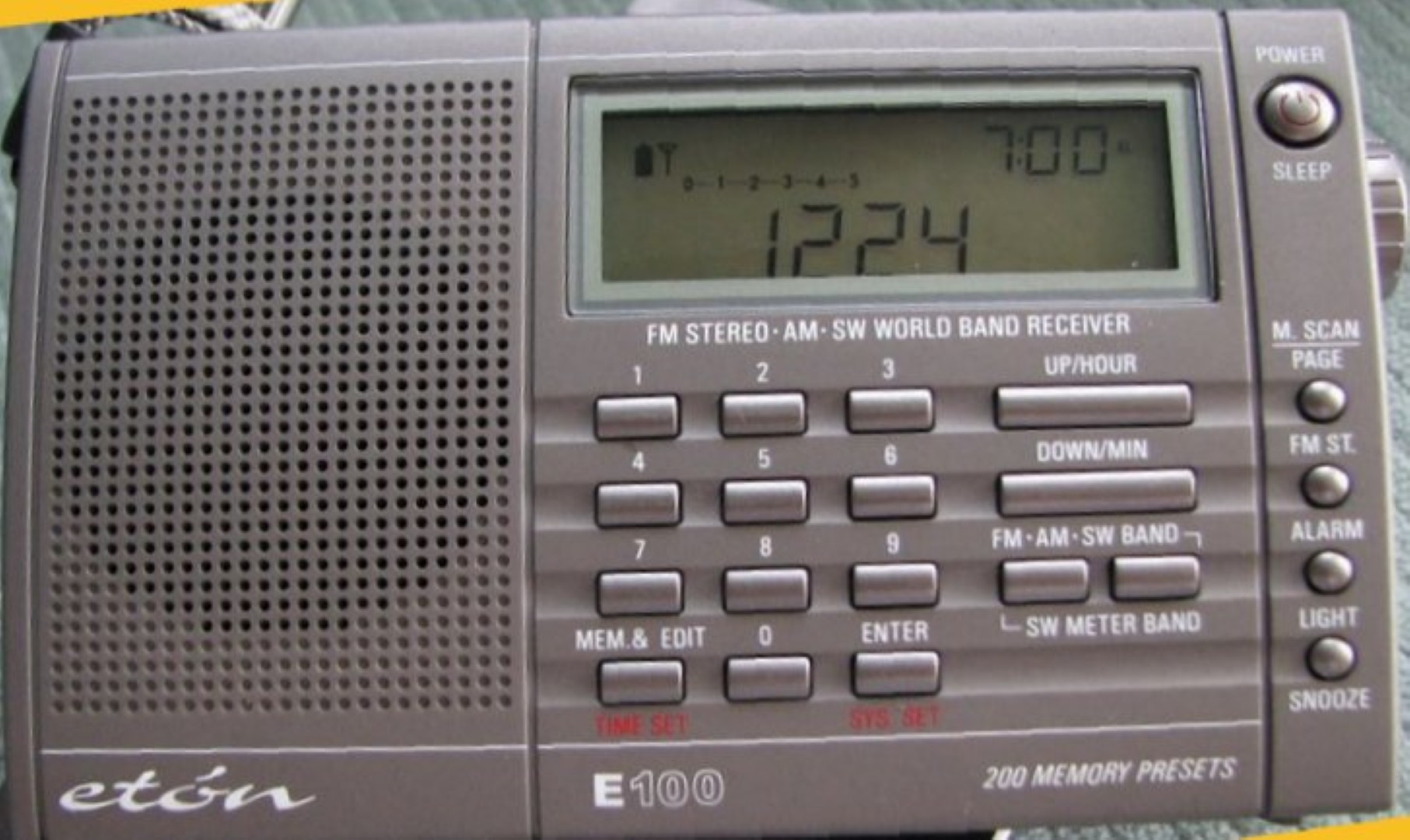
Eton E100/Tecsun PL-200/PL-210 – My Original Review: Introduced 2006 – Typical Price $100 ($159 in 2025) -Later sold as low as $45 (Equals $71.76 in 2025)
Magnavox AW 3625/Philips AE 3625 1993-1994 (No pricing info available)

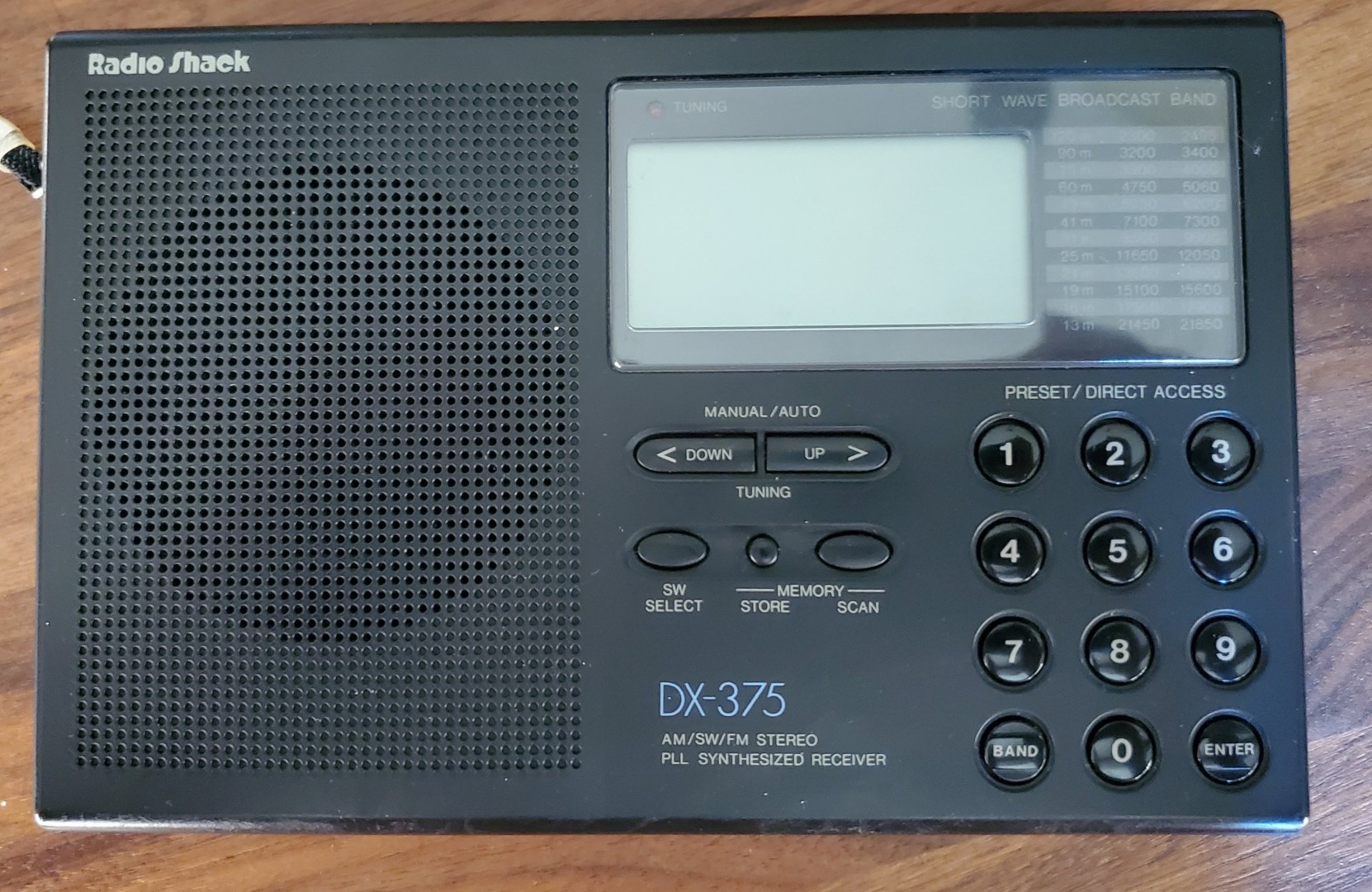
Radio Shack DX-375 – 1995 – 1999 (Catalog Price $100 Equals $210 in 2025)
Tecsun PL-660 – 2011 – 2024 – Typical Price $130 (Equals $186 in 2025)

All of the above is based on archived records and internet research and may not be exact in every detail. I discovered that the Magnavox is a rebranded Philips AE 3625.
Going Back In Time: Although I had never seen the Magnavox/Philips radio before the others are all familiar to me and were popular in their day. My first step was to check each one out to see if they seemed to be working properly and they all were except the Magnavox which had annoying digital noises on most of my usual AM stations. Clearly this was not right and after some research I found this from Radiomuseum.org: “Service documentation shows this model in production in March 31,1993 and lists an AM band interference noise problem coming from the synthesis IC on “issue 2 PCB”. This documentation lists a fix for the problem and also states that the problem is resolved in production by using “issue 4 PCB” from production week 9307 onwards. Another service document dated June 15, 1994 states that a new PCB assembly is used starting from week 9432 due to many changes in the circuit.”
I found a service manual for the Philips online but the quality is poor and it may be tough to locate the components in question but I will attempt that repair and update this when I can. Otherwise, I will test this one on SW and FM only and guess that the AM should be close to the SW performance if the interference can be eliminated. It contains a large ferrite rod which should help and under the interference the actual AM sensitivity seems good.
Since I still had my original, E5 and PL-660 I compared my originals with these newer samples. The E5 was made with a rubberized coating (which was used on many radios and cameras of the period) which later deteriorated into a sticky, gunky mess. I had removed it from my E5, several E1’s (and other radios) but this new sample still had the coating which I will have to remove later. Comparing the two radios they performed identically in every respect and both had even developed the same problem of intermittently not stopping during Auto Scan. Amazingly this happened to both samples as they performed perfectly in all other regards…something else for me to investigate but without service documentation I will probably leave it alone…these radios have internal adjustments in the PLL (Phase Locked Loop) and other circuits which may have drifted over time and which can render the radio useless if tampered with without service information.
Comparisons with modern portables. These radios are a great case study in the march of progress in the design of digital portable radios. They are all pre-DSP (Digital Signal Processing) designs whereas today’s radios all use DSP technology which has matured to the point where it generally offers greatly improved performance and features with lower production costs. They do this by putting all the critical signal path components onto chips which need no alignment adjustments and should contribute to great unit-to-unit consistency and longevity along with lowered production costs. The most recently discontinued model is the Tecsun PL-660 which was made until 2024 but it still harkens back to older times as it remained non-DSP using PLL technology which separates it from today’s newest Tecsuns. In checking all of the vintage models a few trends emerged.
FM Selectivity: Perhaps the biggest development is in the area of FM performance, in some cases dramatically. Although there certainly are some excellent vintage FM tuners, the cost to achieve top performance on FM meant that smaller, more modestly-priced radios lagged far behind. DSP chips offer much better selectivity due to better IF filtering with not only multiple FM bandwidths but better filter characteristics which means modern radios can easily separate stations that bleed over each other on the older radios. Sensitivity and noise mitigation have improved as well.
AM/SW: Surprisingly, the larger vintage radios compared very well in terms of AM/SW reception. The DX-375 has good AM sensitivity and the Eton E5/Grundig G5 is still one of the most sensitive mid-sized portables on AM I’ve ever seen. Both receive very well on these bands with the main advantage of newer models being more features such as multiple bandwidths.
Sound: Modern technology has dramatically improved the sound of the smaller speakers found in compact radios, giving them a much fuller, more balanced audio than was possible in the past. I was happy to hear that the larger of these older radios sounded full and pleasant but the smaller Eton E-100 (along with other compact portables of its day) was very thin and tinny sounding. Today’s compact radios are much more listenable, especially on FM music.
Individual Observations – Tecsun PL-660: As one of the recent models in this survey the PL-660 most closely resembles today’s designs. The two PL-660’s performed identically in every respect except the newer sample (dated 2024) had a mellower sound quality than my early 2011 model which was crisper sounding. In fact, the newer radio in the Hi Tone position sounded almost the same as the original radio on the Lo Tone setting. This difference was not there through earbuds so the difference would appear to be the speaker itself. But I was impressed that my 14-year-old sample pulled in signals on all bands and functioned identically to the 2024 version so its circuits seem extremely stable.
Although newer Tecsuns outperform it overall the now vintage PL-660 has one superiority over all of them and that is its Synchronous Detection. Newer models with sync have very poor sound quality in sync mode and I have been advised that this limitation is inherent in the DSP chips now in use and can’t be changed unless or until new chips resolve the issue. The sync on the PL-660 does not change the sound at all except in situations where it can improve reception and audio recovery and sometimes it greatly improves the quality of what you can hear. In a nutshell, sync replaces the station’s carrier signal with one which is generated in the radio and then synced to the original. One benefit of this is that you can choose to listen to only the Upper or Lower sideband of the signal to eliminate noise or interference and help separate closely-spaced signals. Another is that it can reduce the distortion caused by selective fading which causes gross distortion. Some radios of the past with excellent sync detectors include the Sony ICF-2010, Grundig Satellit 800, Eton E1 and a handful of others. I know of no current day portables with good-sounding sync.
All that said the PL-660 is a pleasant radio to use with no real weaknesses and it offers decent performance although its FM is a bit less selective and sensitive than modern DSP radios and it is not among the best for AM because it is a bit hissier than the E-5 or DX-375.
Eton E5/GrundigG5: These are identical except for their color and are longtime favorites of mine because of their excellent AM sensitivity. I have no other portable of this size that beats them on AM with their built-in antenna. Based on the original Degen DE-1103 which had the same AM performance, the E5/G5 offered an improved user interface including a direct entry keypad and Volume Up/Down buttons making them more user friendly. (At some point the DE-1103 was redesigned and its AM performance suffered). As a later, more upscale model there is a nice set of features including a lighted dial, Dual Conversion, SSB, 700 memories with Alpha Numeric Labelling, 10K/ 9K/ Tuning steps, 2 Bandwidths, Hi/Lo Tone switch, Stereo FM at earphone & Line Out jacks and built-in battery charging if desired.
As a PLL (pre-DSP) design there are some critical circuits which can drift over time and I have had many samples of these that developed problems related to this, mostly dealing with the PLL circuits losing the ability to lock and run. Both of my two current samples still receive well but their scan/stop function is intermittent. SW is also very good…FM is a bit less than we’ve come to expect from today’s DSP designs as I had expected. To me the E5/G5 were landmark portables for their AM sensitivity. I only wish a service manual was available so they could be brought back into perfect alignment. This is a mid-size portable and its sound quality is very nice.
Eton E-100/Tecsun PL-200/PL-210:
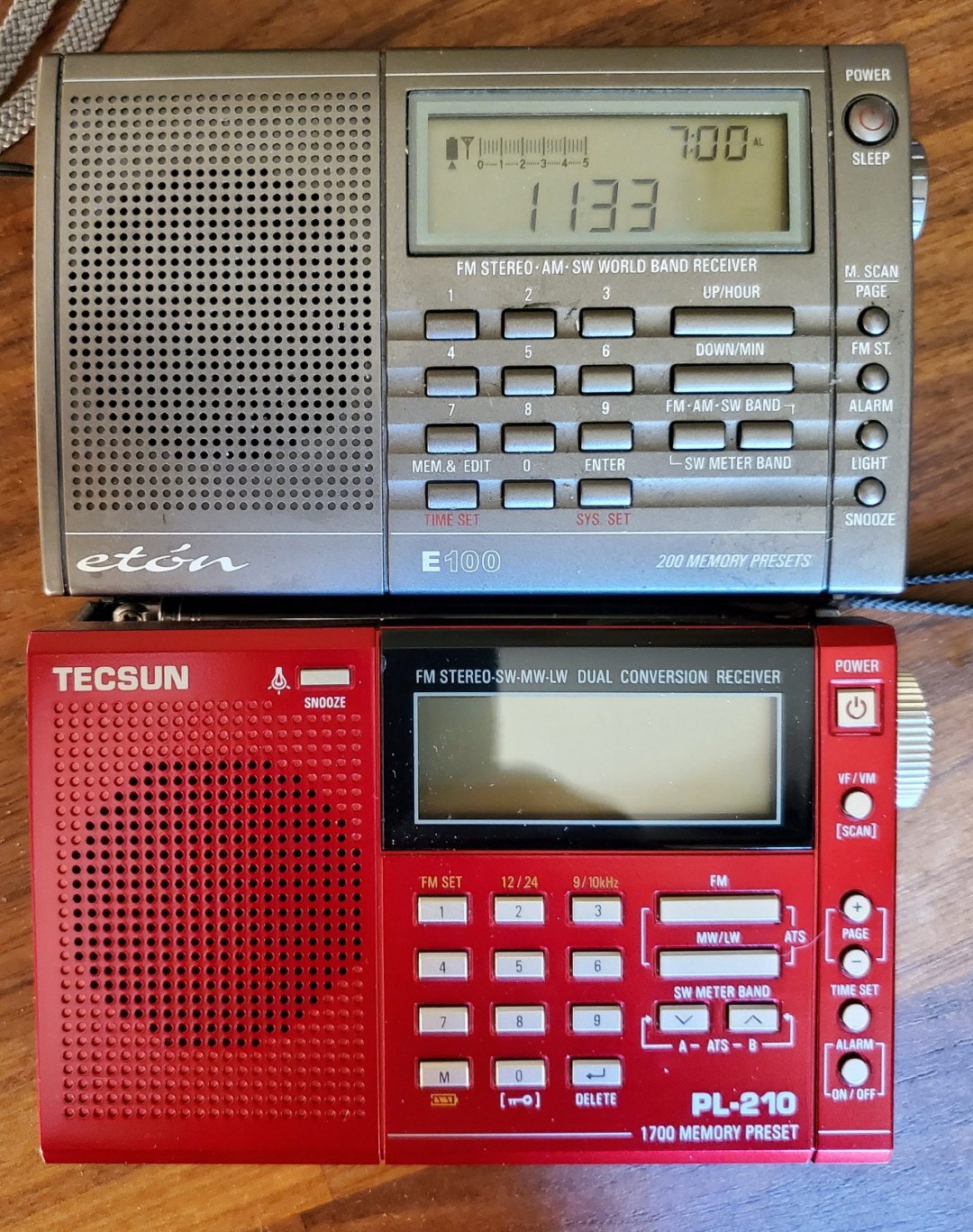

These were cool compact portables in their day and are not bad by today’s standards but they do show their age in a few ways. As expected, the FM band has less sensitivity and selectivity than today’s DSP-based compacts. Today’s portables have also taken advantage of advanced speaker technology and offer much fuller, more balanced audio for their size…these older radios sound thin by comparison. The Tecsun PL-210 was a re-design of the original PL-200 but its performance seemed about the same as the E-100 I just received. Anecdotal evidence suggests the E-100’s may have been upgraded along the way and if this is so it might explain why this one performs identically to my PL-210 which was an improvement over the PL-200 which I no longer have. These still used the old Code Set Page system which you needed to access to change many settings but the PL-200 was feature-rich with 2000 memories, a Hi/Lo Tone switch, 2 AM/SW Bandwidths, 10K/9K/1K Am tuning steps, 3 position Sensitivity switch and FM Stereo.
Radio Shack DX-375:
Many of Radio Shack’s portables were made by Sangean and other manufacturers. Looking at this page from their 1995 catalog:

we can see that the smaller analog DX-351 is a rebadged Sangean SG-711L. I have one of these rebadged as an Emerson PSW4010…the name game is interesting.
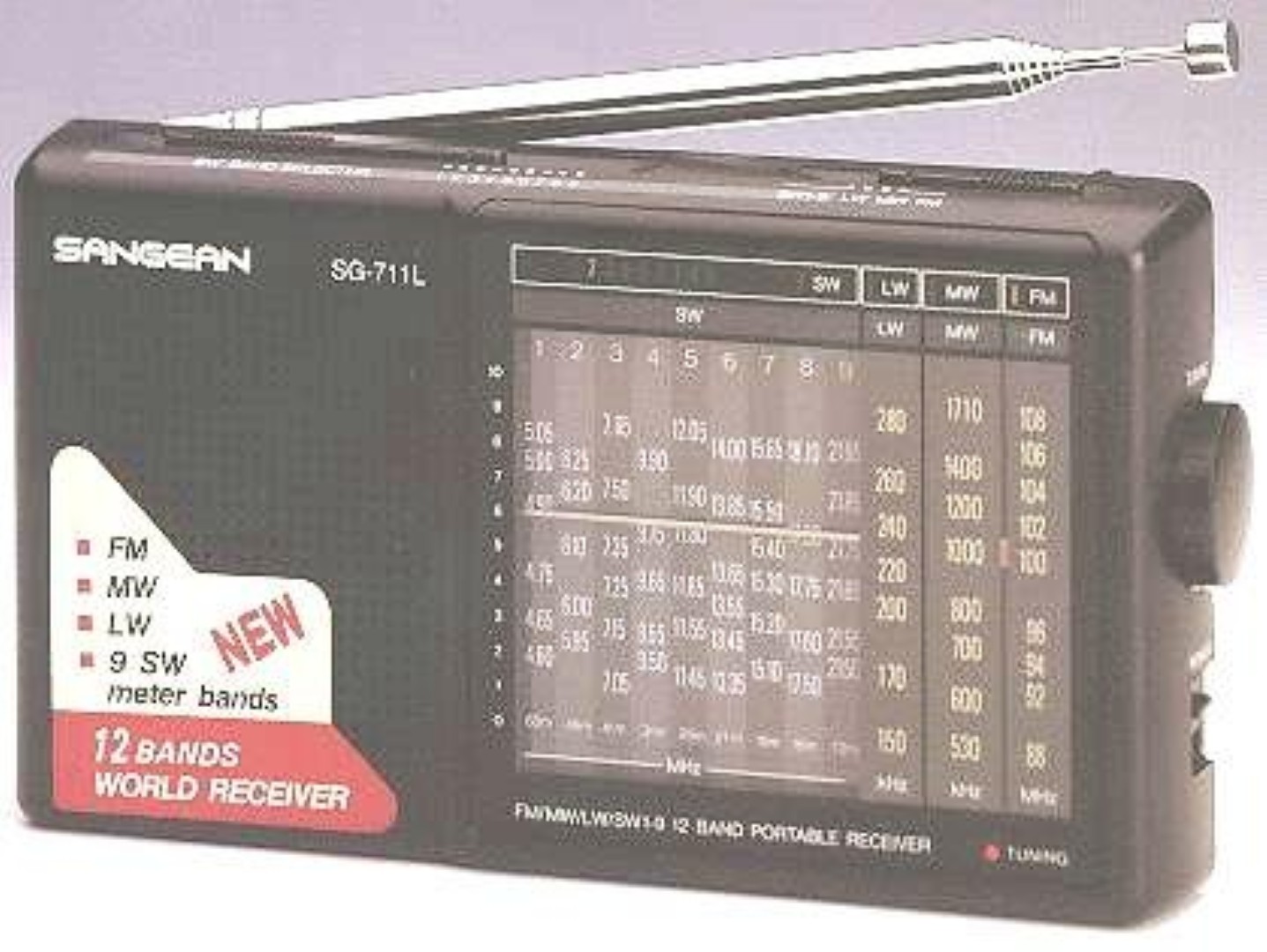
I couldn’t find any info about this on the DX-375 but it was certainly was a very popular model. The consensus is that it was probably made by Sangean but had no direct Sangean-badged counterpart. Although competitive in its day as an early entry-level digital portable, its $100 price equates to $216 in 2025 so we clearly see how technological advances give us more for our money today than we got 30 years ago. Features were fewer than later models with a single bandwidth but a Hi/Lo Tone switch, DX/Local switch and 30 memories. AM/SW reception was very good although there are gaps in the SW coverage and no 1 KHz tuning steps on AM/SW. FM was reasonably sensitive but not selective enough for today’s crowded FM bands. As a larger mid-size portable the sound was full and pleasing.
Magnavox AW 3625/Philips AE 3625:

I couldn’t find any information on the original price of these twins but reaching back to 1993-1994 these could not have been cheap. They seem solid and well-made but have some gaps in SW band coverage. This is an early digital design so features are sparse. It features auto scan, 15 memories (although some literature gives a different number) and, a Hi/Lo Tone switch. Sound is pleasant and again, the AM reception seems good if that interference can be eliminated. SW and FM were also OK but not spectaular. It claims a 12 Hour battery life…these early digital designs were power hungry. Today’s improved batteries would somewhat improve upon this.
Conclusion: Looking back at these radios it is gratifying to see how well some of them performed in specific areas, such as the Eton E5/G5’s excellent AM sensitivity, the DX-375’s large ferrite rod which enhances its AM performance and the PL-660’s good-sounding sync. But I also found that none of them can match today’s DSP portables overall, with modern radios offering far better FM tuners, impressive-sounding speakers in medium and especially smaller radios and a host of features such as excellent IF Filters, sophisticated FM noise mitigating capabilities, multiple bandwidths on all bands, zillions of memories and excellent value for the money. They have also eliminated alignment adjustments so performance should be predictable and stable. Looking at their inflation-adjusted costs none of the much older radios are even remotely close to the bang for the buck we get with a modern portable. I’m a very nostalgic guy and I love these older radios because they remind me of simpler days and the best of them offer decent performance and are simple to operate, but from a practical point of view there is no doubt that in the realm of digital portable radios progress has helped much more than it has hurt.
Special Thanks to reader Richard Johns for sending me the 5 radios used in this report.
Jay Allen
 radiojayallen
You must be logged in to post a comment.